


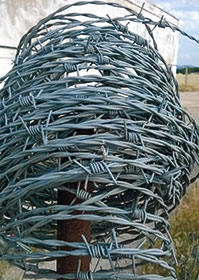
Perimeter security is essential to prevent crime and create alerts before an intruder enters a company’s premises or a residential complex/gated community in order to protect people and assets. However, legacy systems and technologies are rapidly becoming obsolete and new technologies are being adopted to prevent unauthorised access.
This adoption is driven by an increase in intrusion security threats, creating a demand for perimeter protection systems that are more reliable, cost-effective, efficient and better able to keep up with technological advancements. So, what is the best approach to perimeter design?
Typically, when approaching a conventional perimeter design, visual cameras were used. However, this approach required a substantial number of cameras and operators to monitor the images. For example, in the case of an application covering 16 square kilometres (4 km x 4 km), 160 cameras, 160 lights, 160 detectors (1 every 100 m), 16 recorders and 10 LCD screens are required, along with 3-5 operators to operate this set-up. Thus, showing that the use of visual cameras for perimeter design is undoubtedly complex, costly and labour-intensive, both to set up, operate and maintain.
Says Mark Chertkow, MD at Graphic Image Technologies (GIT), “We believe that it’s time to take a fresh approach to perimeter security. By making use of thermal cameras with video analytics in perimeter design where uncooled thermal cameras can operate up to 2000 m depending on the lens used, it becomes possible to cut that equipment list down to 32 cameras (one every 500 m) that require no lights, no detectors and only one recording device, one LCD screen and a single operator. As the operator will be relying on the analytics on the cameras, they will not have to constantly monitor the cameras as he/she will be alerted should there be an intrusion.”
An end to guesswork
“To this end, we’re now offering a comprehensive service to security consultants and our partners, helping them to take a more efficient approach to scoping and designing a perimeter security solution. Using a software tool called Raven, we can assist with the technical design of new perimeter security surveillance applications. These tools use geographical (longitude and latitude) positioning to identify the physical site that needs to be protected and can be used to calculate how many cameras are needed, depending on coverage required.”
This then feeds into the quoting tool, which calculates storage requirements and then produces a bill of materials and camera design layout, which tells the consultant exactly what is required to complete the setup – right down to camera selection and placement. This is a more scientific approach than simply measuring the site and stating that a pole and a camera is required at every 50-metre interval.”
Reducing complexity and costs
Previously, the high cost of perimeter security systems would be considered a constraining factor in market adoption. By using thermal cameras in the perimeter design, it becomes possible to greatly reduce the system complexity and requirements, which has a positive impact on costs. With this simplified approach to perimeter design, fewer cameras are needed, which means less cabling is required and the cost to maintain the solution is reduced.
By making use of thermal cameras, many persistent video imaging problems can be solved and the operator will be able to see clearly, no matter the weather or lighting conditions. Furthermore, thermal cameras have built-in adaptive video analytics that automatically monitor the video feed to differentiate between the different things that could trigger a movement alarm. Video analytics have the effect of virtually eliminating the possibility of false triggers, which ultimately increases system reliability, while reducing the manpower needed to monitor the video feeds.
Thermal cameras require less storage than visual cameras, and none of the peripherals normally associated with visual cameras (detectors, spotlights etc.) in addition to requiring fewer operators. “This means that while more expensive than visual cameras, by using thermal cameras the total costs of ownership will actually be driven down when one considers the benefits of the system as a whole,” Chertkow notes.
For more information contact Graphic Image Technologies, +27 (0)11 483 0333, [email protected], www.git.co.za
| Tel: | +27 11 483 0333 |
| Email: | [email protected] |
| www: | www.git.co.za |
| Articles: | More information and articles about Graphic Image Technologies |






© Technews Publishing (Pty) Ltd. | All Rights Reserved.
 printer friendly version