

Surveillance storage is booming

May 2016 Editor's Choice, Surveillance

In 2013 IHS announced the rise of HD video surveillance was leading to an astonishing 413 petabytes of data a day produced by newly installed video surveillance cameras. Now, the proliferation of higher and higher resolution cameras means that the data deluge continues to increase.

566 petabytes was the amount of data produced in just one day by all the new video surveillance cameras installed worldwide in 2015. (One petabyte = 1024 terabytes, or around one million gigabytes.)

Josh Woodhouse.
Josh Woodhouse.

Just how much data is 566 petabytes:

• 11.3 million standard double-layer Blu-Ray movie disks.

• All Netflix’s current (as of December 2015) users streaming 1.2 hours of ultra-high definition content simultaneously.

• Approaching twice the amount of all user data stored by Facebook.

Why this increase?

Globally speaking, the video surveillance market is still not saturated. A recent IHS report on the installed base for video surveillance equipment suggested that there was one camera installed for every twenty-nine people on the planet. However, camera density varied drastically by country. The mature markets of the US and the UK had one camera installed for every eight and eleven people respectively. Emerging markets such as India (one for every 150) or Middle East and Africa (one for every 200) will see many new installations.
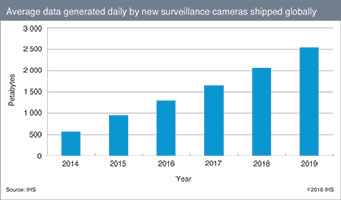
Figure 1.
Figure 1.

As well as new installations, retrofits and upgrades are a significant part of the market, a market which globally is expected to see a CAGR of 20% in new camera unit shipments from 2014 to 2019. In addition to the high demand for surveillance cameras, the following is also true:

• HD compliant 1080p 25/30 fps cameras have established themselves as the minimum expected from new cameras. This is not now limited to network cameras, HD CCTV has emerged as the replacement for many remaining standard definition analogue cameras.

• Panoramic and 4K cameras are two further storage hungry high-growth product categories.

• When video surveillance footage is being stored, it is generally being retained for an increasing period of time. Aside from out-and-out security purposes, video surveillance footage is being increasingly retained longer for anti-litigation, insurance and operational purposes too.

The amount of data produced by video surveillance cameras is huge, yet it is often overlooked in analyses of general worldwide data production and storage. The video surveillance industry is still somewhat below the radar for those involved in data storage, perhaps due to its challenges and characteristics.

Management and storage of potentially hundreds of high resolution video streams can be one such challenge. A large throughput capacity and a heavy write focus are just two characteristics of enterprise storage tailored for video surveillance workloads.

The traditional separation of security and IT has meant convergence between the two has been slow. However, increased surveillance storage demands may force many end-users to re-assess their storage solutions as previous approaches will no longer be sufficient. If enterprise storage is used, the majority of demand at present is being fulfilled by IP SANs.

Chinese video surveillance vendors are well positioned to ramp-up their offerings of low-priced, high capacity SAN systems to meet the capacity requirements of the mass video surveillance market. This approach, previously reserved for only the largest installations, is filtering down to smaller systems. However, the market is also evolving.

Concurrently, some larger installations have progressed to the use of smarter storage architectures integrating moving data between edge and core storage, between multiple tiers (in some cases storage media) within single platforms which are all viewable in the VMS. Current IT megatrends such as hyper-convergence, virtualisation and software defined storage are still a long way off from affecting the majority of video surveillance installations.

Yet, improvements in the efficiency of how recorded footage is managed throughout its lifetime are beginning to drive new approaches to video surveillance storage design. This is critical to keep up with the video surveillance data deluge.

For more information contact Josh Woodhouse, senior market analyst - video surveillance, IHS Technology, +44 1933 402 255, josh.woodhouse@ihs.com


Share this article:
Share via emailShare via LinkedInPrint this page


Further reading:

Banking’s AI reckoning
Commercial (Industry) Surveillance Access Control & Identity Management Fire & Safety Perimeter Security, Alarms & Intruder Detection Information Security Asset Management News & Events Integrated Solutions Infrastructure Security Services & Risk Management Education (Industry) Entertainment and Hospitality (Industry) Financial (Industry) Healthcare (Industry) Industrial (Industry) Mining (Industry) Residential Estate (Industry) Retail (Industry) Transport (Industry) Conferences & Events Products & Solutions Associations Videos Training & Education Smart Home Automation Agriculture (Industry) Logistics (Industry) AI & Data Analytics Facilities & Building Management IoT & Automation Power Management
From agentic commerce disputes to quantum-powered risk modelling, SAS experts offer a ‘banker’s dozen,’ 13 industry-defining predictions that will separate institutions that master intelligent banking from those still struggling with the basics.

Read more...
Axis signs CISA Secure by Design pledge
Axis Communications SA News & Events Surveillance Information Security
Axis Communications has signed the United States Cybersecurity & Infrastructure Security Agency’s (CISA) Secure by Design pledge, signalling the company’s commitment to upholding and transparently communicating the cybersecurity posture of its products.

Read more...
Five key technology trends for the security sector in 2026
Axis Communications SA News & Events Surveillance
Axis Communications examines trends it considers important for 2026, as technology and customer requirements continue to evolve, but the basic security needs of end users remain constant.

Read more...
AI agent suite for control rooms
Milestone Systems News & Events Surveillance AI & Data Analytics
Visionplatform.ai announced the public launch of its new visionplatform.ai Agent Suite for Milestone XProtect, adding reasoning, context and assisted decision-making on top of existing video analytics and events — without sending video to the cloud.

Read more...
What is your ‘real’ security posture?
BlueVision Editor's Choice Information Security Infrastructure AI & Data Analytics
Many businesses operate under the illusion that their security controls, policies, and incident response plans will hold firm when tested by cybercriminals, but does this mean you are really safe?

Read more...
What is your ‘real’ security posture? (Part 2)
BlueVision Editor's Choice Information Security Infrastructure
In the second part of this series of articles from BlueVision, we explore the human element: social engineering and insider threats and how red teaming can expose and remedy them.

Read more...
ONVIF to end support for Profile S
News & Events Surveillance
ONVIF has announced that it will end support for ONVIF Profile S and recommends using its successor, Profile T. Profile S is the first-ever profile introduced by ONVIF in 2011.

Read more...
IQ and AI
Leaderware Editor's Choice Surveillance AI & Data Analytics
Following his presentation at the Estate Security Conference in October, Craig Donald delves into the challenge of balancing human operator ‘IQ’ and AI system detection within CCTV control rooms.

Read more...
Onsite AI avoids cloud challenges
SMART Security Solutions Technews Publishing Editor's Choice Infrastructure AI & Data Analytics
Most AI programs today depend on constant cloud connections, which can be a liability for companies operating in secure or high-risk environments. That reliance exposes sensitive data to external networks, but also creates a single point of failure if connectivity drops.

Read more...
Toxic combinations
Editor's Choice
According to Panaseer’s latest research, 70% of major breaches are caused by toxic combinations: overlapping risks that compound and amplify each other, forming a critical vulnerability to be exploited.

Read more...


While every effort has been made to ensure the accuracy of the information contained herein, the publisher and its agents cannot be held responsible for any errors contained, or any loss incurred as a result. Articles published do not necessarily reflect the views of the publishers. The editor reserves the right to alter or cut copy. Articles submitted are deemed to have been cleared for publication. Advertisements and company contact details are published as provided by the advertiser. Technews Publishing (Pty) Ltd cannot be held responsible for the accuracy or veracity of supplied material.


© Technews Publishing (Pty) Ltd. | All Rights Reserved.

