

Low pressure water mist technology

September 2015 Editor's Choice, Fire & Safety

I-CAT Environmental Solutions has appointed Sperosens as distributor of the I-CAT range of water mist and foam mist fire extinguisher products and systems. These were launched on 25 June at the CSIR’s Kloppersbos test facility.

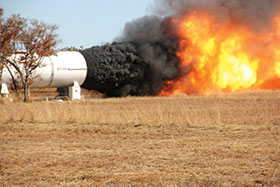
The day kicked off with an introduction by Professor JJL du Plessis, Sasol Mining Chair: SHE, University of Pretoria. This was followed by a presentation by I-CAT managing director, James van Reenen. The proceedings continued with a host of demonstrations and fire simulations for the 160 guests from the mining and industrial market sectors.

The I-CAT range of extinguishers offers cost-effective, environmentally friendly solutions for almost every fire suppression application. It includes hand-held portable water mist and foam mist extinguishers, vehicle systems and localised fixed systems using T-Rotor technology. Application of the low pressure water mist and foam mist can extinguish any type of fire with minimal collateral damage. In addition to this range, the Firetrace automatic detection and suppression system for local or in-cabinet protection can employ most commercially available suppression agents, including Novec, foam or DCP, to ensure the most suitable agent is used for a particular hazard.

The handheld water mist and foam mist extinguisher nozzles create a mist halo that protects fire fighters, operators and trapped victims from flames, radiated heat and smoke. The technology is completely safe for people, property and the environment and keeps post-fire damage to a minimum. The effectiveness lies in the mist droplet sizes – between 50 and 75 microns – with no chemically active substances present to cause damage. The mist contains air, thus the people it protects can breathe freely with no risk of asphyxiation. The products are certified in accordance with SANS 1910:2009 and the extinguishers also carry international approvals and quality standards like CE, EN3 and MPA Dresden.

The I-CAT vehicle protection systems create a fine atomised mist which cools the environment down gradually without causing thermal shock to equipment. Foaming agent is added to prevent any Class B fire from spreading if fuel or hydraulic lines rupture and cause engine fires. Operation and installation on vehicles ranging from buses and mining vehicles to boats and aircraft is easy, with very low maintenance costs. Downtime and cleanup after activation is minimal and there is no threat to the environment. The systems carry the internationally recognised FM approval.

Localised application systems for protecting conveyor belts, transformers, generators and other high value equipment can operate in extreme working conditions and confined spaces. They come with detachable Schrader valve gauges. This allows the system cylinder pressure to be verified by simply screwing off the gauge while observing if it loses pressure, and screwing it back on while observing the gauge indicating repressurisation.

This ensures that the user can check that the system is active and ready at any time. I-CAT systems are designed to reduce maintenance costs. Once a system has been activated it only requires a quick refill and repressurisation to put the system back into service and this can be done onsite. All systems can be pressure tested onsite and put back into service within minutes.

The effectiveness of the Firetrace standalone suppression system is due to the linear heat detection tubing that ruptures and delivers the agent directly at the origin of the fire when it is exposed to heat or flame. This specialised detection tubing combines leak resistance, flexibility, durability and temperature sensitivity, allowing it to react quickly at the point of origin of the fire. The tubing connects to custom engineered valves and a Firetrace cylinder that contains the most suitable fire suppression agent for the particular hazard.

Installation is simple, and self-activation ensures that the fire is reliably suppressed within seconds. Firetrace can be installed in virtually any enclosed space where high value assets such as electrical cabinets, medical equipment, IT server racks and UPS units are located.

For more information contact Marihette Hattingh, Sperosens, +27 (086) 177 3767, marihette.hattingh@spero.co.za, www.spero.co.za


Share this article:
Share via emailShare via LinkedInPrint this page


Further reading:

Global security in 2026
Editor's Choice News & Events Security Services & Risk Management Industrial (Industry) Mining (Industry)
The World Security Report 2026 states: “In a world of increasing volatility, physical security has evolved. It is no longer just a defensive measure; it is a critical driver of corporate value.”

Read more...
Who is to blame for autonomous mistakes?
Editor's Choice Security Services & Risk Management Industrial (Industry) Mining (Industry)
Most supply agreements for AI-integrated equipment still closely resemble plant hire contracts from ten years ago: bilateral, human-focused, and silent on who bears the risk when a machine makes a decision on its own.

Read more...
Beyond the checkpoint
Veracitech Editor's Choice
For decades, mining corporations have treated employee screening as a necessary friction point, an operational cost to be managed rather than a strategic capability to be optimised. A new generation of full-body X-ray technology, purpose-built for the realities of high-throughput precious-metals environments, is beginning to change that calculus.

Read more...
Persistent surveillance with rapid deployment
Editor's Choice
Sky Robots has introduced an aerial drone system designed to operate as a consistent layer within security environments, addressing long-standing challenges around visibility and response across large or complex sites.

Read more...
The control room problem that nobody wants to talk about
Technews Publishing Editor's Choice
WhatsApp has become the unofficial backbone of security communications across the mining and industrial sectors, but it was never designed to be a security tool.

Read more...
Controlling access for people and vehicles
IDEMIA STid Security Technews Publishing Editor's Choice Access Control & Identity Management Asset Management Industrial (Industry) Mining (Industry)
When it comes to access control, the security requirements of mines and the industrial sector are similar, requiring a layered approach that combines physical barriers, digital authentication, and continuous monitoring to protect personnel, assets, and operational continuity.

Read more...
The AI goldrush has a credibility problem
Refraime Editor's Choice Surveillance AI & Data Analytics
The single most important question a surveillance buyer can ask is deceptively simple: “Was this system programmed or was it trained?” That question alone will reveal more about what you are evaluating than any feature list or marketing video.

Read more...
Crime behaviour insights more important than ever
Leaderware Editor's Choice Surveillance Training & Education AI & Data Analytics
Behavioural surveillance skills are as essential now as they have ever been, especially in situations where quick evaluation of context is needed. Training operators in behavioural recognition skills is a vital part of control room success.

Read more...
Proactive estate security in Cape Town
neaMetrics OneSpace Technologies Technews Publishing SMART Security Solutions Fang Fences & Guards ATG Digital Editor's Choice News & Events Integrated Solutions Infrastructure Residential Estate (Industry)
SMART Security Solutions started the year with our annual SMART Estate Security Conference in Cape Town on 26 February 2026. Held at Anna Beulah Farm, the conference saw a number of delegates enjoying the farm’s excellent cuisine, while listening to outstanding presenters.

Read more...
How AI video is reshaping real estate security
neaMetrics TRASSIR - neaMetrics Distribution Editor's Choice
Globally, property maintenance and facility operations spending is projected to grow to over US$145 billion by 2034, reflecting rising complexity, compliance pressures, and increased exposure to operational costs. AI systems can protect properties, automate access, and optimise building management.

Read more...


While every effort has been made to ensure the accuracy of the information contained herein, the publisher and its agents cannot be held responsible for any errors contained, or any loss incurred as a result. Articles published do not necessarily reflect the views of the publishers. The editor reserves the right to alter or cut copy. Articles submitted are deemed to have been cleared for publication. Advertisements and company contact details are published as provided by the advertiser. Technews Publishing (Pty) Ltd cannot be held responsible for the accuracy or veracity of supplied material.


© Technews Publishing (Pty) Ltd. | All Rights Reserved.

