

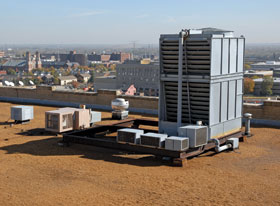
HVAC performance degrading?

September 2014 Security Services & Risk Management

Regular maintenance can ensure that HVAC equipment remains efficient, but it could also cut energy costs. Part failure can seriously impact the performance of equipment, so it makes good sense to keep an eye on key components that have the greatest energy impacts. However, there are also significant benefits to be gained by switching to a whole-building-system approach, applying best practices and implementing effective scheduled maintenance.

Studies show that:

* Use of best practices in building maintenance and operations can reduce energy use by 10 to 20%.1

* Poor maintenance practices can increase energy use by 30 to 60%.1

* Programmes to enhance the efficiency of HVAC and lighting systems can decrease energy bills by 5 to 20% in commercial buildings2, without significant capital investment.3

* Effective scheduled maintenance can decrease energy bills by 15 to 20%.

As more studies show the benefits of a proactive approach and energy costs continue to climb, companies are stepping up their HVAC maintenance schedules even further, switching from a reactive ‘break-fix’ approach and from standard ‘scheduled maintenance’ practices prescribed by manufacturers to a predictive maintenance approach which bases maintenance on the actual condition of the machine.

A look at how common component performance issues in various types of chillers can degrade energy performance is a good incentive to begin to migrate to this approach, proactively monitoring performance and assessing the status of chiller components with the greatest energy impacts. Our top 10 are:

Neil Cameron
Neil Cameron

Centrifugal chillers

1. Dirty tubes – Microbes and the formation of scale or iron deposits in the chiller tube bundle reduce heat transfer. A water treatment program and tube cleaning could lead to a 10-15% saving in energy consumption.

2. Condenser flow rate – A 20% reduction in the condenser flow rate will increase full-load energy consumption by 3% in mechanical and absorption chillers used in chemical process cooling.

3. Oil contamination in refrigerant – There is a 2% loss in chiller efficiency for every 1% of oil found in the refrigerant. It is not uncommon to find 10% oil in the refrigerant of older chillers.

4. Sub-optimal refrigerant levels – Correcting refrigerant levels can provide up to 20% saving.

5. Leaks in the compressor can result in higher condenser pressure and temperature – About 1 psi of air in a condenser equates to a 3% loss in chiller efficiency.

Rooftop units

6. Economiser failure – Repair could deliver a 14 – 40% saving on energy consumption.

7. Airflow problems – Correcting to standard levels could deliver 10% savings.

8. Thermostat control problem – Correction could provide up to 40% savings.

9. Sensor problems – If a repair enables a non-functioning economiser, savings of up to 40% can be gained.

10. Suboptimal refrigerant charge – Correcting levels could lead to a 5 to 11% energy savings.

For a more detailed look at what could go wrong and how to fix it, see our Energy Savings from Maintenance fact sheet at http://www.institutebe.com/InstituteBE/media/Library/Resources/Existing%20Building%20Retrofits/Fact-Sheet-IBE-Energy-Savings-from-Maintenance.pdf

References:

1. Frankel, M., Heater, M. and Heller, J. 'Sensitivity Analysis: Relative Impact of Design, Commissioning Maintenance and Operational Variables on the Energy Performance of Office Buildings' New Buildings Institute. August 2012.

2. Portland Energy Conservation 1999c. Operation and Maintenance Assessments: A Best Practice for Energy-Efficient Building Operations. September 1999.

3. Chimack, M. J. Aardsma., D. Novosel. Energy Reduction through Practical Scheduled Maintenance. National Center for Energy Management and Building Technologies. November 2006.

For more information contact Johnson Controls, +27 (0)11 921 7141,  [email protected] www.johnsoncontrols.com


Share this article:
Share via emailShare via LinkedInPrint this page


Further reading:

The line between locking residents out and restricting their access
News & Events Security Services & Risk Management Residential Estate (Industry)
A June 2026 High Court judgment has clarified one of the most contested issues in modern estate governance: when an HOA's digital access restrictions amount to unlawful self-help or spoliation, and when they do not.

Read more...
Modernise field communications with Push-to-Talk over Cellular
Products & Solutions Security Services & Risk Management
Sentiv is bringing Hytera’s Push-to-Talk over Cellular (PTToC) portfolio to organisations that need a more structured and controlled way to coordinate field teams, without extending a full private radio model to every team, site, or function.

Read more...
SAFPS urges taxpayers to remain alert to fraud
Security Services & Risk Management News & Events
The SAFPS warns taxpayers about evolving SARS scams this tax season, highlighting common fraud tactics, practical prevention tips, and trusted reporting channels to stay protected.

Read more...
Zero-touch automation certificate life cycle management loop
Products & Solutions Information Security Security Services & Risk Management
ManageEngine completes the certificate life cycle management loop with CA-agnostic, zero-touch automation. New post-deployment automation in Key Manager Plus removes the last manual step in certificate renewal as lifespans gradually shrink to 47 days

Read more...
Fire safety in South Africa
Technoswitch Fire Detection & Suppression Technews Publishing SMART Security Solutions Fire & Safety Security Services & Risk Management Editor's Choice
Fire safety is sometimes ignored, sometimes relegated to whatever is cheapest, and sometimes treated with the seriousness it deserves, given that it focuses on protecting life and assets. SMART Security Solutions asked Brett Birch, MD of Technoswitch, for some insights into the realities of fire safety in South Africa.

Read more...
Nimbus remote fire alarm management
Technoswitch Fire Detection & Suppression Security Services & Risk Management Fire & Safety
Nimbus connects key stakeholders to their fire alarm systems, simplifying compliance with fire safety standards and greatly improving visibility into critical events, thereby augmenting first responder processes that save lives and protect assets.

Read more...
Sophos launches AI-native cybersecurity defence system
News & Events Information Security Security Services & Risk Management
Built for a threat landscape reshaped by AI, Sophos Fusion unites security operations, endpoint, network security, identity, email, and cloud into one defence system that prevents, detects, investigates, and responds at AI speed.

Read more...
Stop supplier fraud at the moment of payment
News & Events Security Services & Risk Management
Cape Town-built platform bridges the gap between onboarding and transaction by securing identity inside the live channels where companies exchange invoices and banking details.

Read more...
Ungoverned AI agents and deepfakes pose critical threats
Information Security Security Services & Risk Management
Global study reveals 64% of South African organisations already deploy autonomous AI agents with little to no governance, while 63% of employees admit they are unlikely to be able to spot attacks such as deepfakes

Read more...
A risk-based approach to fire safety
Fire & Safety Security Services & Risk Management Industrial (Industry) Agriculture (Industry)
A report by fire engineering consultancy ASP Fire is challenging blanket assumptions around combustible-core sandwich panels, arguing instead for a rational, risk-based approach that balances fire safety requirements with commercial realities in sectors such as agriculture, manufacturing and industrial processing.

Read more...


While every effort has been made to ensure the accuracy of the information contained herein, the publisher and its agents cannot be held responsible for any errors contained, or any loss incurred as a result. Articles published do not necessarily reflect the views of the publishers. The editor reserves the right to alter or cut copy. Articles submitted are deemed to have been cleared for publication. Advertisements and company contact details are published as provided by the advertiser. Technews Publishing (Pty) Ltd cannot be held responsible for the accuracy or veracity of supplied material.


© Technews Publishing (Pty) Ltd. | All Rights Reserved.

