


Whether driven by the rise in online shopping or simply by the cost savings available from modern centralised distribution models, warehouses are springing up in key transport hubs around southern Africa - and they are getting bigger. This trend brings a number of challenges to effective fire detection.
On the one hand, large spaces require powerful devices that can sample air volumes rather than relying on smoke to reach them. Ceilings 40 m high or more mean smoke from a small fire will stratify before it reaches passive detection points. At the same time, racking systems are getting tighter, increasing fire loads and adding further obstacles to any system that relies on line of sight. The spread of smoke is also hindered, while heat builds up among a huge fire load.
Although sprinklers can help reduce fire damage and shorten recovery time, they can also be destructive to anything from foodstuffs to electronics. Only a well-designed Early Warning Fire Detection system (EWFD), alongside staff trained for rapid response, provides real risk mitigation.
Aspirating smoke detection is required
An aspirating smoke detector consists of a sensor and a control unit incorporating a fan, and one or more tubes extending outward to sample air over a large area. One immediate benefit of this is that testing and maintenance can be carried out at a convenient point on the ground. Because each unit can protect a large area, far fewer units need to be tested than with standard smoke detectors.
Testing and maintenance efficiencies are a major ROI advantage, but ASD also allows greater design flexibility. Tubing arrays can be adjusted as needed to accommodate new warehouse layouts, which is particularly useful when tubes are used vertically within racks to enable multi-level detection. Such vertical, in-rack sampling is critical for very high ceilings and when tight racking constrains the airflow, smoke can be trapped within the goods area. However, with other systems, it becomes challenging to reach the units for testing or to adjust systems when racks are rearranged.
Finally, an advanced ASD system offers the reliability that key economic infrastructure deserves. There is no point in investing in state-of-the-art logistics if the chain cannot be relied upon, 365 days a year. The relatively small investment in EWFD, often offset by superior ROI over the long term, is therefore not just worth it, but essential.
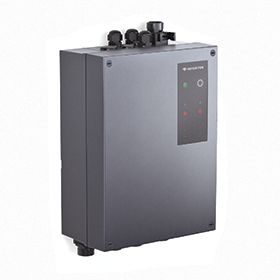
The new SecuriSmoke ASD 2000 model is designed to bring aspirating smoke detection into the digital age. It is also Securiton’s most powerful device ever: it can cover more space, offer greater design flexibility, and provide the earliest possible warning of an incipient fire. This gives operators a great chance of putting out the fire before it does damage or becomes too dangerous to tackle.
Because it was built with a 21st-century user in mind, the ASD 2000 offers a new way of working for designers and installers: 3D design software, set-up and commissioning over an app. Its unprecedented power and sensitivity also make it an ideal option for protecting large, complex warehouses, and Securiton’s range still includes more modest devices offering excellent detection levels for every space.
Huge potential loss
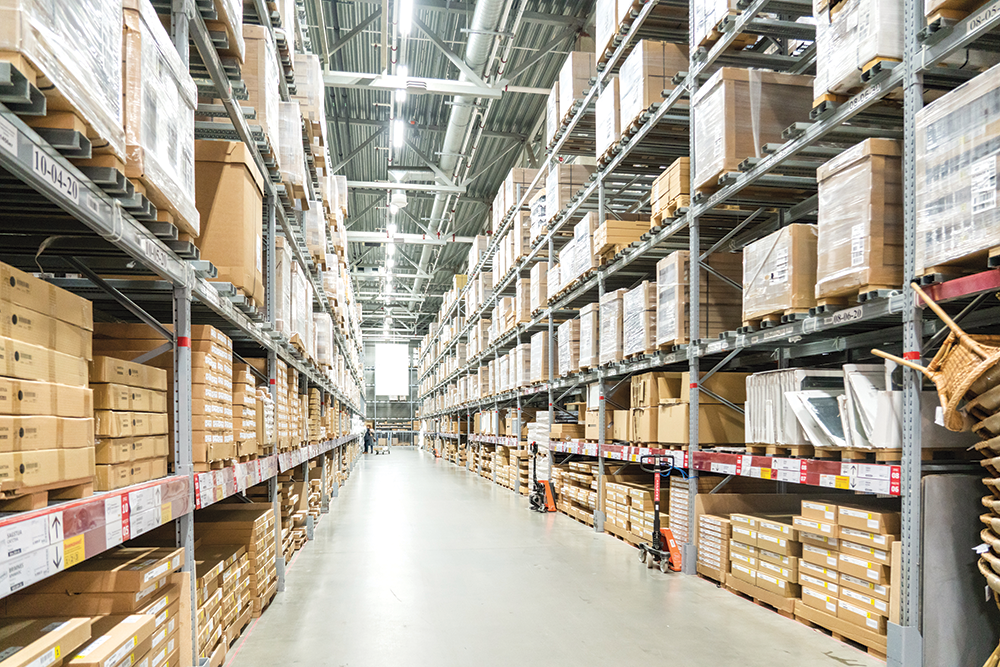
With businesses increasingly relying on just a few huge warehouses – or even just one – its loss would be disastrous. Should one be lost overnight, business continuity is threatened as a supplier can no longer deliver promised levels of service. By the time the stock and the facility are replaced, customers will inevitably have moved elsewhere.
For warehouses that supply manufacturing, the effects can be even worse, with many factories relying on timely supply intake. They could be forced to stand idle, while alternative sources are found. Unlike warehouse losses and goods losses, these losses are uninsurable and threaten the very existence of a business. This reinforces the need for fire detection, which goes beyond regulatory compliance and offers a real chance for tackling any blaze before it gets out of control.
Fire risks in modern warehouses
• Huge fire loads – flammable goods can be stacked 40 m high.
• Narrow racking – flames can easily jump aisles.
• Critical assets – both the goods and the warehousing infrastructure are crucial to supply chains.
Challenges to fire detection
• High ceilings – stratification, dilution and difficulty of access for maintenance.
• Configurable racks make it hard to install in-rack detection.
• Vast areas – and can be more than 100 000 m2.
Advantages of SecuriSmoke ASD 2000
• High sensitivity – sensitivity levels as low as 0,001% obs/m.
• Low-maintenance reliability – new LED detection chamber with a built-in centrifugal separator minimises direct exposure to dust in the airflow.
• Huge coverage for very early warning fire detection – up to 62 sampling points, while still maintaining Class A performance standards.
• Extensive coverage per device – the 1000 Pa German aspiration engine used in the ASD 2000 supports a 700 m aggregated pipe run and can sample air at a distance of 150 m from the main control unit.
The ASD 2000 was an unprecedented development effort for Securiton and a large investment in the future of aspirating smoke detection:
• Five years from concept to launch.
• Team of more than 60 engineers.
• Development with an agile framework (constant feedback).
The development does not end with the launch of ASD 2000 at the start of 2026. New features and improvements are set to follow in planned waves.
For more information contact Securiton AG,






© Technews Publishing (Pty) Ltd. | All Rights Reserved.
 printer friendly version