


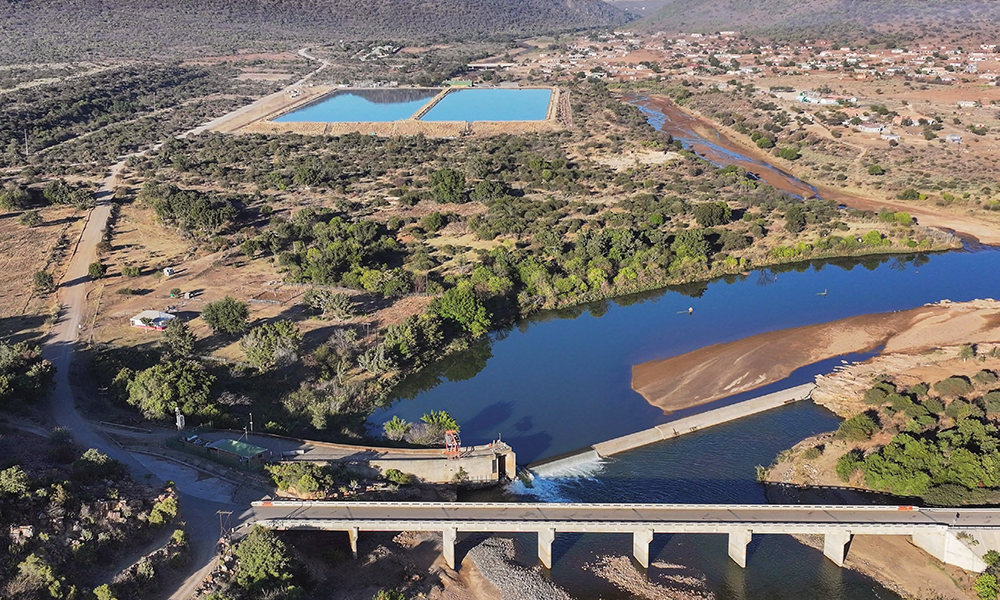
The Badirammogo Water User Association (BWUA), formerly known as Lebalelo, has played a pivotal role in the development of bulk raw water infrastructure in Limpopo, South Africa, since 2002.
The Association was established to provide bulk raw water to mines, primarily Platinum Group Metals (PGM) and chrome mining companies, and to communities, through the Department of Water and Sanitation, in the Eastern Limb of the Bushveld Igneous Complex located within the Sekhukhune District Municipality.
With its head office in Pretoria and operational headquarters in Modubeng, it operates and maintains over 125 kilometres of infrastructure, achieving over two decades of uninterrupted supply with minimal water losses.
Guided by its purpose of improving lives through water, BWUA positions itself as a trusted infrastructure partner for both public and private sectors. Its mission is to support regional growth by delivering bulk raw water, supporting potable water supply, and constructing regional infrastructure that is cost-effective, efficient, and environmentally responsible.
BWUA’s values are safety, collaboration, integrity, empowerment and sustainability. It is also deeply committed to sustainable development, regional economic growth and community wellbeing. These principles are reflected in its operations, as well as its NOSA 5-star platinum status and ISO certifications, strengthening its reputation in the water utilities sector.
The challenge: securing a critical water supply
Despite its operational success, BWUA faced significant security threats to its infrastructure and personnel. A key water supply site, essential to both mining clients and rural communities, was increasingly targeted by vandalism, theft, and social unrest. These incidents put infrastructure such as pump stations and office facilities at risk, endangered staff safety, and disrupted the continuous delivery of water. Vandalism damaged pipelines, air chambers, and valves.
Given the unique challenges due to BWUA’s remoteness and the complexity of its operations, Gallagher Security was called in to provide critical security support.
Morne Grobler, Gallagher’s general manager for Africa, says the challenges BWUA faced were complex. “BWUA needed a solution that could secure remote sites, reduce reliance on physical guards, and ensure uninterrupted service delivery, while remaining aligned with its values and long-term strategy.”
The solution
“BWUA partnered with Gallagher Security as the Technology Partner to implement a comprehensive, technology-driven security solution across its infrastructure,” says Grobler.
The system was designed by Consulting Engineer Mark Baillie of Drewmark Consulting and deployed by Reinhard van Rooyen, who at the time worked at CORTAC, one of BWUA’s appointed implementation partners. Van Rooyen is now employed by BWUA and brought extensive knowledge of the challenging terrain.

“In Africa, water is a massive issue. Compared to electricity infrastructure, laying down a pipeline is far more complex, but with the right systems, it is possible,” says Baillie. “What we came up with had never been done before on a linear infrastructure basis in this country. We had to navigate vast, unforgiving terrain and rethink everything from the ground up.
“One of the high sites near the head office was about 7 kilometres away, but it took two hours to reach by 4x4. That is the kind of terrain we were dealing with – mountains, isolation, and no connectivity.”
Van Rooyen agrees, saying the team built everything from scratch, including connectivity, infrastructure, and security. “The Gallagher platform was central to making it all work, integrating access control, surveillance, and smart locks.”
Van Rooyen and Baillie used key Gallagher products to develop their unique approach to keeping BWUA’s people and operations safe.

First, they used Gallagher’s Bluetooth-enabled biometric access system to enable remote admission and token entry, eliminating the need for contractors to travel long distances to obtain access permissions. “The Bluetooth biometric access solution was a game-changer. We can issue tokens remotely, anywhere in the world, without needing to see the person in person. That is huge for project managers and contractors working in remote areas,” says Baillie. “We integrated cut-and-climb sensors, electrified fencing, and smart locks, which are all wirelessly connected to the Gallagher platform. It is a layered security approach that works even in the most remote locations.”
They used motorised gates integrated with Gallagher’s systems to ensure secure entry points.
Van Rooyen says they placed sensors throughout buildings and pump stations, which feed into the Gallagher platform, enabling real-time alerts and automated camera activation. “We used smart locks on pipeline manholes that are made from a special material that cannot be pried open or repurposed. They are electronically controlled and programmed through the network, so we know they are secure and efficient.”
CCTV and heat vision cameras were also deployed to provide operational oversight, early warning of environmental hazards, and support health and safety monitoring. Gallagher’s infrastructure also includes outdoor hotspots to ensure coverage across mountainous terrain and remote sites.
“Now, the system is automated and secure, and it has made a real difference,” says Baillie.
Safer and smarter operations
Grobler is pleased to share that since implementing Gallagher’s solution, BWUA has seen dramatic improvements. “Security incidents have dropped from frequent vandalism to less than a handful of incidents over the years. Staff numbers have reduced from 30 to 40 guards to just four, with remote monitoring replacing physical presence. Security personnel are no longer exposed to safety threats, and that is a heartening result. The system is now largely unmanned, driven by processes and remote technology.”
CCTV footage has helped identify operational issues, such as dam overflow risks and structural vulnerabilities caused by wildlife. “We even had a case where a rodent burrowed into a dam support wall. The CCTV picked it up, engineers responded, and the issue was resolved before it became a problem. That is the level of visibility we now have,” says Van Rooyen.
“Through our CCTV capabilities, we also spotted a crocodile in one of our dams. It meant we could warn everyone quickly and call the wildlife centre to come and catch it. Security used to mean putting lives at risk. Now, with CCTV and automated response systems, we can monitor and react within minutes, without needing someone on-site.”
BWUA is implementing the Olifants Management Model Programme (OMMP), a R25 billion (capital expenditure), source-to-tap infrastructure programme that will expand bulk raw and potable water supply across Limpopo. The same security model has been specified for deployment across the entire OMMP infrastructure, commencing with Stage 1, which includes approximately 123 km of bulk raw water pipeline from Flag Boshielo Dam to Sekuruwe, together with pump stations, associated water treatment works, and an integrated energy solution.
Conclusion
Gallagher’s integrated security platform has empowered BWUA to protect critical infrastructure, reduce costs, and improve safety across vast, challenging terrain. The partnership continues to evolve, supporting BWUA’s mission to improve lives through water and infrastructure.
For more information contact Gallagher Security,






© Technews Publishing (Pty) Ltd. | All Rights Reserved.
 printer friendly version