


G4S, the international business of Allied Universal, recently released its World Security Report 2026, stating, “In a world of increasing volatility, physical security has evolved. It is no longer just a defensive measure; it is a critical driver of corporate value.”

This report contains findings gathered from 2 352 security chiefs at companies with combined revenue exceeding $25 trillion, as well as 200 institutional investors managing assets worth over $1 trillion. It provides strategic insights from industry professionals, helping them better assess how to secure people and assets.
 Credit: World Security Report 2026.
Of the primary factors impacting corporate security, the report highlights the following:
• Concern about the safety of business leaders has risen sharply, as nearly half (42%) of security chiefs from large, global companies say the threat of violence toward company executives has increased in the last two years. Global institutional investors underscore this escalating risk: 97% deem it important for companies to invest in the security of their executives, and 7 in 10 say that the contributions of senior executives represent 30% or more of the value of the companies they invest in.
• Misinformation and disinformation (incorrect or purposely false) are pervasive and can put senior executives at greater risk of harm. Three-quarters of CSOs (75%) say their companies were targeted by such a campaign last year and 42% say mis- and disinformation motivates at least half of the threat actors targeting their businesses. Activist groups, which often deploy this tactic, increasingly pose a physical security risk to facilities and executives, according to 85% of investors.
“In a world of increasing polarisation, and when mistruths and untruths can be shared instantaneously, companies and their senior leaders face heightened risks. As a CEO, this impacts me personally and professionally. Now more than ever, personal safety is on my mind and the minds of my loved ones. Professionally, I’ve seen an increase in our customers’ concern for the safety of their employees,” said Steve Jones, Allied Universal global chairman and CEO.
• The report also finds that the financial impact of security incidents is substantial. A quarter of security chiefs (26%) reported revenue losses following an incident last year, with the average company losing at least $9 million. In total, the companies surveyed lost close to $1 trillion in revenue due to physical security incidents. This is consistent with the 2023 findings. Investors say a physical security incident could impact the value of a publicly listed company by up to 32%, up 3 percentage points from 2023.
• The ramifications of a security incident can be considerable and go beyond taking a short-term financial hit. Investors say the impact can be much more damaging and long-lasting, particularly when reputation and shareholder value are concerned. Given how high the stakes are, business leaders are increasingly recognising that robust physical security is a corporate value driver and should be central to their corporate governance and risk management strategy,” said Ashley Almanza, executive chairman of G4S, Allied Universal’s international business.
Sub-Saharan African security
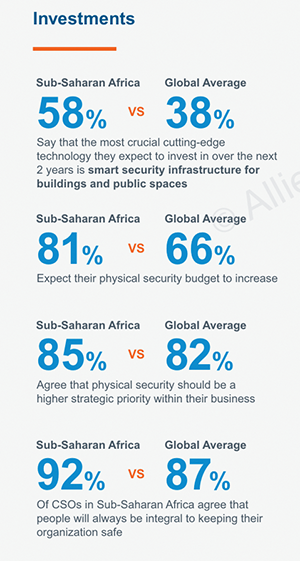
The report focuses on the sub-Saharan region, noting that it leads the world in anticipated increases in physical security budgets, with 81% of chief security officers (CSOs) expecting their budgets to grow over the next 12 months, significantly above the global average of 66%. When placed in the larger context of global regional insights, this surge in funding outpaces all other areas:
• Latin America: 72% expected increase.
• Middle East: 70% expected increase.
• Asia Pacific: 66% expected increase.
• Europe and North America: Tied for the lowest expected budget increases globally at 58%.
The allocation of these expanding budgets in the region is heavily focused on technological advancement. Investment in new security technology and infrastructure is the top budget priority for 71% of the region’s CSOs, the highest rate globally, compared with the 47% global average. Specifically, 58% of companies in the region plan to invest in smart security infrastructure for buildings and public spaces, and 52% intend to adopt AI-powered video surveillance, analytics, and biometric access controls.
This massive budget increase aligns with a broader strategic shift. Alongside Latin America, sub-Saharan Africa leads the world in recognising the strategic value of physical security, with 85% of CSOs agreeing it should be a higher strategic priority within their businesses. This urgent prioritisation and spending may be a direct response to the region’s unique and severe threat landscape; sub-Saharan Africa anticipates higher impacts from climate change (42%), external fraud (40%), and internal fraud (39%) than anywhere else in the world.
 Credit: World Security Report 2026.
Additional key findings
Measures to mitigate the threat of violence to company executives
• 49% of security chiefs say they have enhanced their security procedures (e.g., enhanced background checks, on-site firearms or explosives screening).
• 45% say they are carrying out risk assessments for leaders (e.g., pre-event assessments, travel risk management, technical surveillance counter-measures).
• 44% are monitoring online threats (e.g., social media, deep web, dark web).
• 35% are providing leaders with personal/close security personnel.
• 34% are providing leaders with personal protective equipment (e.g., body armour, secure vehicles, emergency escape masks).
• 25% are providing family protection for leaders.
Security-impacting hazards
• 78% say geopolitical tensions will compromise the security of their supply chains.
• Economic instability is the dominating hazard over the next year, 44% say, up from 36% in 2024.
• 33% say climate change events (e.g., long-term shifts in weather patterns, extreme temperatures), up from 29% in 2024.
• 30% say there will be disruption to energy supplies, up from 27% in 2024.
• 29% say war or political instability, up from 22% in 2024.
External security threats
• Over the next 12 months, external threats are expected to jump to the same level as internal threats, which were previously more significant.
• Fraud is expected to increase to 30% next year, up from 22% in 2024.
• Theft of company physical property is anticipated to rise to 28%, from 20% in 2024.
• Malicious damage to company property is expected to jump to 27%, from 16% in 2024.
Internal security threats
• The top two internal security threats for next year are the leakage of sensitive information (32%) and unauthorised access to company resources or data (28%).
• The top drivers of intentional insider threats include:
• Misinformation or external radicalisation (39%).
• Financial stress or personal debt (37%).
• Financial dissatisfaction (36%).
Budgets
• Physical security budgets will increase in the next 12 months, 66% of security chiefs say.
• The top security budget priorities for the next 12 months are:
• Investment in new security technology and infrastructure (47%).
• Employee security training and upskilling (45%).
Priorities
• 80% of CSOs say company leaders are more concerned with cyber than physical security.
• 92% of investors say physical security should have a higher strategic priority within businesses.
• Fraud and the leakage of sensitive information are the top two internal security threats investors consider most important for companies to prepare for (59% and 45%, respectively).
• Fraud is the top external security threat investors believe companies they invest in should prepare for (53%).
View the report at https://worldsecurityreport.com/






© Technews Publishing (Pty) Ltd. | All Rights Reserved.
 printer friendly version