



In the surveillance industry, scale has always been constrained. The more sites you need to monitor, the more operators you need, and therefore, the greater the costs. However, with increased adoption of AI video analytics in the control room, this changes that equation.
At a basic level, AI has been adopted to tackle the persistent operational challenge of nuisance alarms in control rooms. Traditional surveillance systems generate large volumes of alerts, overwhelming operators managing sites.
Ensuring these nuisance alarms are filtered out of the control room operator’s workflow has become the bread and butter of AI surveillance as monitoring centres aim to operate more efficiently. However, while false alarm reduction is absolutely essential, it is only the starting point for what AI video analytics can achieve. The real opportunity lies in moving beyond false-alarm filtering and into intelligent decision-making, thereby substantially reducing the cognitive workload on operators.
From detection to understanding
AI video analytics is on a fast track to shift from simple object detection (person/vehicle detection) to behavioural analysis (“What is that person doing and does this represent a threat?”).
This shift is important, especially in 24/7-access properties where human presence is legitimate and expected.
The more sophisticated approach to this focuses on identifying patterns that may be associated with risk.
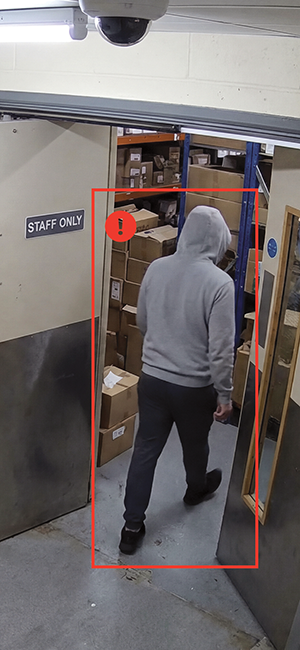
Case study: Doncaster Security Operations Centre and the evolution of the ARC
A leading example of how this evolution can be put into practice is the DeepAlert Suspicious Activity model, which was implemented in self-storage sites monitored by Doncaster Security Operations Centre (DSOC) in the United Kingdom. DeepAlert has enjoyed a strong working relationship with DSOC, and when they approached us seeking a solution to detect genuine threats, we were excited to leverage our AI video analytics expertise to build one. DeepAlert and DSOC collaborated to integrate behaviour-based analytics into their self-storage solution.
After a few weeks of scoping the project, collecting data, and building the algorithm, DeepAlert delivered an intelligence layer that ignored legitimate users, while detecting and alerting on suspicious behaviour. This enabled DSOC’s control room operators to prioritise interventions effectively, and only when necessary.
The impact on operations was immediate and measurable. Operator efficiency increased as the monitoring centre was able to manage a larger number of sites without adding to its headcount, thereby increasing operational margins. Response times were reduced, and quality improved as alerts became actionable and led to faster, better-informed decision-making.
The business case for intelligent scaling
The DSOC case study demonstrates the value of intelligent AI video analytics beyond simple intruder detection. It enables monitoring centres to expand their businesses without linear increases in headcount and related costs. Secondly, it enables providers to offer a more proactive, intelligence-led surveillance service with greater actionable insights. Lastly, these models are designed to integrate into existing infrastructure, leveraging legacy systems and making them far more intelligent and valuable.
As AI continues to evolve, the most successful surveillance operations will be those that not only reduce nuisance alerts, but also derive meaningful business intelligence from video data. This decision-making intelligence is what will truly enable businesses to scale, and as the DeepAlert-DSOC case study shows, the future of control rooms everywhere is not about watching more screens, but about making the right decisions and responses quickly and accurately.
| Tel: | +27 21 201 7111 |
| Email: | [email protected] |
| www: | www.deepalert.ai |
| Articles: | More information and articles about DeepAlert |






© Technews Publishing (Pty) Ltd. | All Rights Reserved.
 printer friendly version