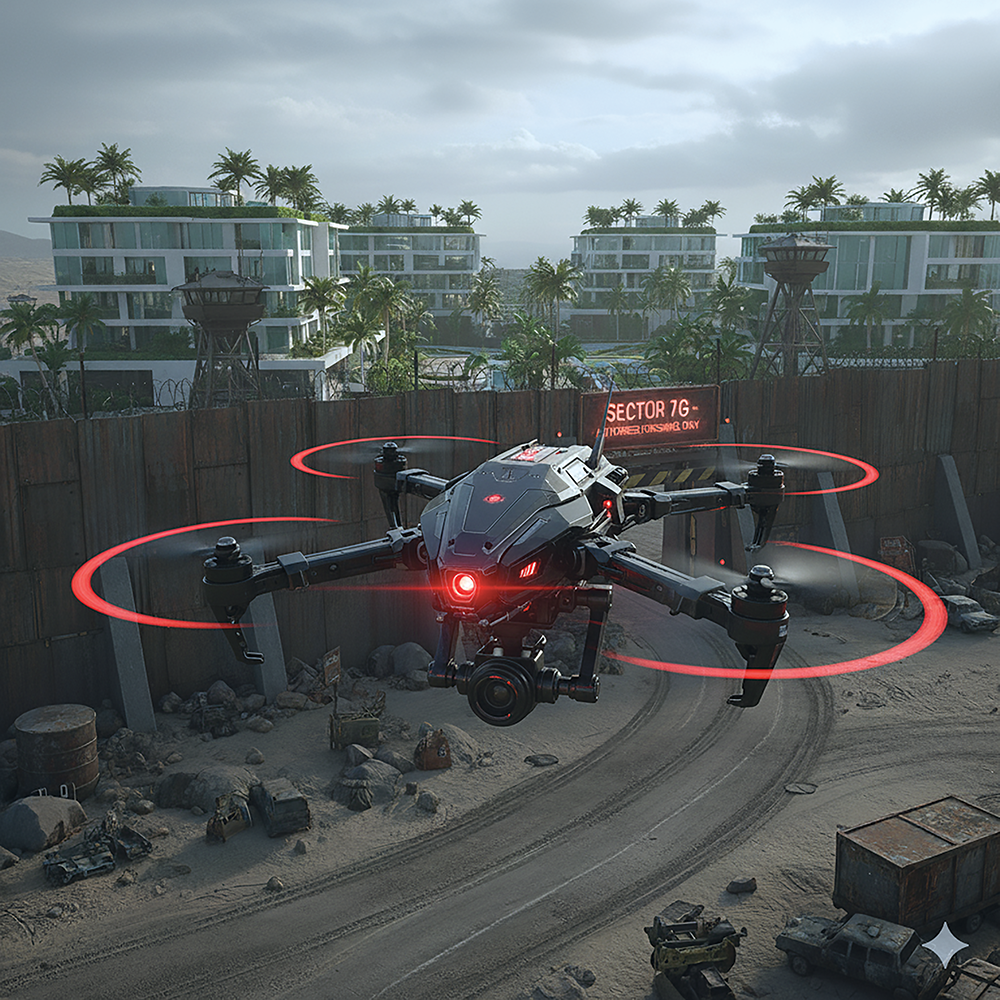
Drones, or unmanned aerial vehicles, have come a long way since we first started seeing their utility in the security industry. Along with the technical advances, we saw legislation designed to promote the secure use of drones and prevent any potential privacy invasions – although one always has to question the capability of authorities to effectively enforce any legislation in South Africa.
In the residential estate market, the initial excitement of using drones for perimeter patrols and tracking intruders was quickly subdued due to the high cost of drones, the need for qualified pilots, and the potential for complaints about drones peeking into windows. No matter how good the technology, however, estate residents want the best security (as long as it does not inconvenience them), but they baulk at paying for it. The same applies to manned guarding; only the best will do, at the lowest cost.

However, as the service delivery model of many technologies has changed over time, so have the models developed for drone security. While estates can use drones for much more than security, in this article, we will focus primarily on the security aspects.
In terms of the evolution of drones and the technologies associated with them, such as thermal cameras, which allow control rooms to view what is happening on the ground in any light conditions, we have also seen much change. One of the more interesting changes is increased intelligence, which we have to ascribe to AI, since not mentioning artificial intelligence in relation to any technology is almost unthinkable today.
Michael Lever, technical director at 24/7 Drone Force, a division of 24/7 Security Services, highlights intelligent drone solutions through the company’s docked drone solution, which it offers using the DJI Dock system. The docking station was on display at the SMART Surveillance Conference in July this year (a brief review of the conference is at www.securitysa.com/25631r). Using the docking station, drones can automatically take off and land, recharge, and pack themselves away for transport to another location.
According to Lever, “docked drones provide cost-effective, elevated security and situational awareness. They can cover large perimeter areas and integrate seamlessly with existing security platforms such as CCTV, perimeter sensors, electric fences, panic buttons, and alarms. This enables both proactive patrols and rapid, effective first responses to alarms.”
As noted, drones are particularly valuable at night as thermal imaging capabilities allow for fast detection and response from an elevated vantage point - something ground teams cannot achieve with their limited line of sight.
Integration is key to drone success
While drones can go anywhere, irrespective of obstacles, and provide important information to ground staff on the potential threat (and they can track people inside the estate, if required), they cannot stop intruders or make an arrest. The idea of shooting intruders from drones is possible (depending on who you ask), but one may find oneself in a pickle with the police. Integration and synchronisation with other technologies, and especially ground staff, is therefore a critical aspect of any drone service.
The 24/7 Drone Force solution seamlessly integrates with third-party systems to provide control-room staff, management, and responding officers with real-time situational awareness. The solution includes live video feeds, the drone’s precise location and direction, and data overlays from additional sensors, all consolidated into a single platform. “This ensures ground teams and aerial assets can collaborate seamlessly for faster, more effective responses,” he adds.
The old saying that you should not send a guard armed with a baton to confront criminals with AK-47s is still relevant today. Drones make it easier and safer for security personnel to identify the number of intruders, their identities in limited cases, and the weapons they possess.
The cost factor remains
Cost and legislation have historically been hurdles in the adoption of drone technology. However, with the maturation of the technology, costs have significantly reduced. The services model now offers a cost-effective solution to gain the functionality of drones without the burden of high capital outlay and maintenance costs.
“To further reduce expenses, we are scaling our command centre operations and leveraging remote piloting, which lowers the need for onsite staff,” notes Lever. “A ‘drones-as-a-service’ model is increasingly viable for estates and companies with limited budgets, as it removes the burden of capital outlay, maintenance, and regulatory compliance. That said, strict adherence to privacy, data security, and protection legislation remains essential.”
Compliance and privacy
One of the biggest challenges the security industry faces is regulations such as POPIA, and in the case of drones, compliance with South African Civil Aviation Authority (CAA) regulations. The CAA requirements are complex, but can be managed. However, a new code of conduct proposal specifically for community schemes is currently being considered, which will be added to POPIA at some stage, potentially disrupting security efforts.
Lever says that strict compliance is essential when it comes to drone operations. Operators must ensure flight paths are followed, records are transparent, and logs are readily available for auditing or community concerns. In terms of privacy, he advises that open engagement with residents is not just a good practice, but a necessity. It helps to build trust and ensures that the use of drones is always in the best interest of the community.
From a regulatory perspective, strict compliance is paramount in drone operations. Operators, pilots, operations, and aircraft must all meet specific regulatory approvals, with comprehensive record-keeping and constant updates. This dual focus on compliance and transparency ensures that estates can effectively address both regulatory and privacy challenges, instilling a sense of security in the community.
While the CAA regulations prohibit fully autonomous flights, in other words, automated operation without a pilot controlling or managing the drone, 24/7 Drone Force has managed to obtain permission for semi-autonomous operations for pre-scheduled patrols and mission profiles. “This allows us to maintain compliance, while ensuring the pilot remains in control, ready to respond to incidents in real time. In addition, scheduled operations with licensed beyond visual line of sight (BVLOS) pilots continuously monitor the operations and are ready to take manual control should that be necessary.”
BVLOS permission was granted through the development of detailed standard operating procedures (SOPs), safety protocols, and specialised communication systems such as Radio over IP (RoIP). The 24/7 command centre functions as the nerve centre, enabling licensed BVLOS remote pilot operators to monitor real-time video feeds, manage missions, and coordinate with ground security teams.
“The result is that 24/7 Drone Force delivers fully integrated aerial intelligence through docked drone technology, semi-autonomous Drone-as-First-Responder (DFR) capabilities, and precision BVLOS operations, monitored and managed by our CAA-compliant command centre staffed with licensed remote pilots,” Lever says. “Our services range from automated perimeter patrols to real-time emergency response, enhanced by AI analytics, pre-programmed missions, and seamless integration into broader security workflows.”
Looking ahead, he predicts that drone solutions will develop further, using predictive analytics for better results, along with smarter integration between systems, and more sophisticated applications centred on asset protection, law enforcement support, and critical infrastructure inspections. Lever believes that this will enhance situational awareness and improve operational efficiency to an unparalleled level.
For more information contact 24/7 Drone Force,






© Technews Publishing (Pty) Ltd. | All Rights Reserved.
 printer friendly version