

There’s no power, or there’s too much power …

SMART Estate Security 2024 Power Management, Residential Estate (Industry)

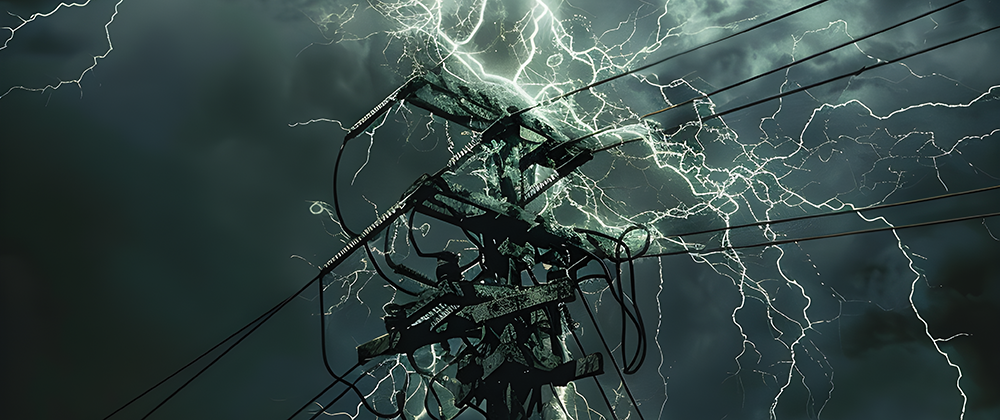
South Africa is rated as one of the countries with very high lightning activity. In addition, we are also exposed to a high rate of switching transients (commonly known as surges) exacerbated by an unstable power supply grid.

Therefore, we are exposed to a heightened risk of equipment damage in both industrial and domestic environments.

The Lightning Flash Density map (https://shorturl.at/L55VJ) provides a clear picture of the annual lightning activity in South Africa, emphasising the need for proactive measures to protect our equipment.

Equipment protection

Lightning transients

Devices that protect equipment against lightning transients are classified as Type I devices. These devices typically can handle energy of up to 100kA.

Switching transients

Switching transients are more frequent and have a higher voltage intensity, but have a short duration. These transients can be generated in a number of ways, as indicated below.

• Contactors.

• Collapsing inductive loads.

• Power grid switching.

• Power grid failure.

• Component failures.

• Human error.

• Compressors.

• DC drives.

• Motors.

• Electrostatic discharge.

• N.E.M.P. (Nuclear Electro Magnetic Pulse).

• Improper grounding techniques.

The most common switching transient is loadshedding and power failures on the national grid. These cause major problems in the home, business, and industrial environments.

Type 2 devices

Devices that protect equipment against switching transients are normally classified as Type 2 devices. These devices typically can handle energy of varying currents (5kA to 200kA).

Type 3 devices: For sensitive equipment

Type 3 devices for the protection of sensitive devices are normally positioned as close as possible to the units requiring protection. These devices can typically handle switching transients of up to 20kA. They are typically used for mains, signal, and data protection.

What to protect?

When considering a lightning and switching protection solution, all wires used for the transmission of mains voltage, measurement and control technology, information technology, telecommunications, and transceiver applications must be considered. Should any of the total protection solutions be omitted, transients will find an unprotected gateway and damage or destroy equipment.

The only transmission lines (increasingly used for data and telecommunication transmission) that are impervious to lightning are fibre optic cables.

Earthing

Lightning and surge protection devices rely on an effective earth to divert excess energy away from protected equipment. It is important to note that all earth points must be bonded together and, in turn, bonded back to the main earth. A poor earthing system means poor or no protection.

No earthing system means no protection.

Find out more at www.drensky.co.za


Share this article:
Share via emailShare via LinkedInPrint this page


Further reading:

SMARTpod talks about HomeSec Expo 2026
SMART Security Solutions Technews Publishing News & Events Residential Estate (Industry) Videos
SMARTpod, the podcast from SMART Security Solutions, finds out more about the upcoming HomeSec Expo happening at Gallagher Estate on 4 & 5 March 2026.

Read more...
Luxury residential access
Access Control & Identity Management Residential Estate (Industry)
Clifftown Shore is an exclusive collection of 51 luxury 1, 2 and 3-bedroom seafront apartments and penthouses set within a protected conservation park area, served by CAME’s XiP system and door entry system.

Read more...
Intelligent access at the gate
Access Control & Identity Management Residential Estate (Industry)
LD Access provides a smart, streamlined approach to boom gate security, enhancing the verification of people and vehicles before entry. Through its Self-Service Scanning Kiosk and Mobile Scanning Unit, LD Access delivers secure, automated access control.

Read more...
Risks of open-source intelligence escalating in crime
Security Services & Risk Management Residential Estate (Industry) Smart Home Automation
CMS estimates that open-source intelligence has played a role in 20 - 30% of robberies over the past 12 months. In cybercrime, global research consistently shows that many offences rely on some form of open-source data exploitation.

Read more...
Can calcium solve stability issues in sodium-ion batteries?
Power Management
Sodium-ion batteries (SIBs) are a promising, low-cost alternative to lithium-ion batteries for both personal electronics and large-scale energy storage, but their adoption is limited by their poor stability in air and water.

Read more...
Risks of fire safety in residential environments
Fire & Safety Residential Estate (Industry)
ASP Fire is highlighting the significant fire risks in residential environments and stressing the importance of proactive fire-safety management at the household level.

Read more...
Fire Ops SA Partners with Matrix
News & Events Fire & Safety Residential Estate (Industry)
Fire Ops SA, a South African private fire and rescue service, has announced its partnership with Matrix Vehicle Tracking to launch FireStop, providing Matrix and Beame clients with direct access to a dedicated professional private fire service.

Read more...
Who has access to your face?
Access Control & Identity Management Residential Estate (Industry) AI & Data Analytics
While you may be adjusting your privacy settings on social media or thinking twice about who is recording you at public events, the reality is that your facial features may be used in other contexts,

Read more...
Human-centric control rooms
Iritron Integrated Solutions Surveillance Residential Estate (Industry)
Iritron and Oculus show that when it comes to control rooms, people, not just technology, are at the centre of the most significant performance differentiators today, not just how efficiently the technology works.

Read more...
Multiple IoT devices targeted
Information Security Residential Estate (Industry)
Mirai remains one of the top threats to IoT in 2025 due to widespread exploitation of weak login credentials and unpatched vulnerabilities, enabling large-scale botnets for DDoS attacks, data theft and other malicious activities.

Read more...


While every effort has been made to ensure the accuracy of the information contained herein, the publisher and its agents cannot be held responsible for any errors contained, or any loss incurred as a result. Articles published do not necessarily reflect the views of the publishers. The editor reserves the right to alter or cut copy. Articles submitted are deemed to have been cleared for publication. Advertisements and company contact details are published as provided by the advertiser. Technews Publishing (Pty) Ltd cannot be held responsible for the accuracy or veracity of supplied material.


© Technews Publishing (Pty) Ltd. | All Rights Reserved.

