

2024 State of Security Report

April 2024 Editor's Choice

HID has published its 2024 State of the Security Industry Report, which gathered responses from 2600 partners, end users, and security and IT personnel worldwide, across a range of job titles and organisation sizes representing over 11 industries.

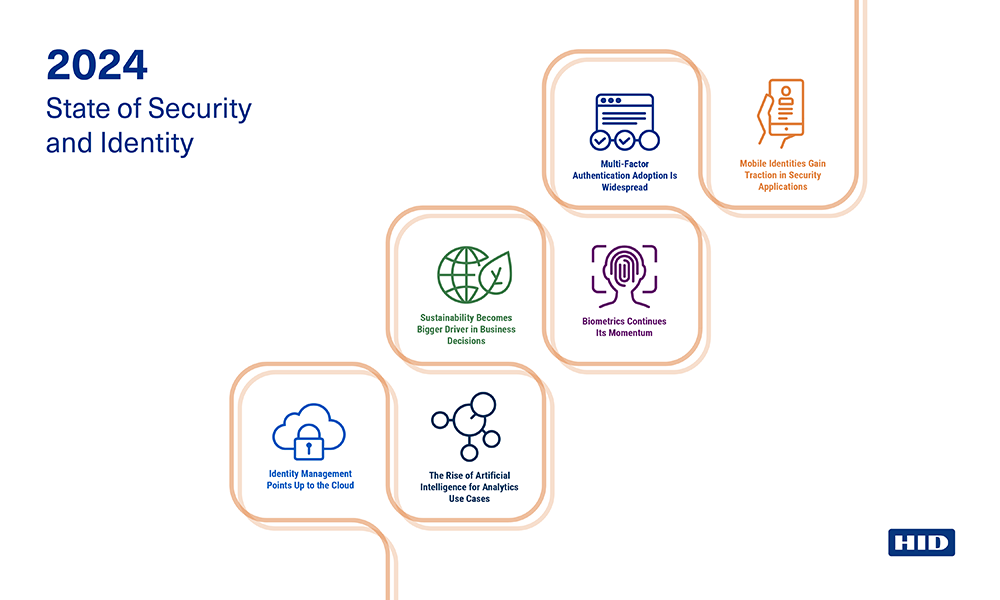
The 2024 State of Security Report delves into the underlying concerns driving upcoming innovations and the technologies underpinning them, helping security leaders proactively adapt to evolving challenges. This year’s survey reveals six themes.

Mobile identity is expected to be ubiquitous

Given the widespread use of mobile devices, momentum continues to build around their use to support identity. Within the next five years, surveyed end users state that nearly 80% of organisations will deploy mobile IDs. Industry partners are even more optimistic, stating that 94% of their customers will have deployed mobile IDs.
MFA is widespread despite slow but growing implementation of Zero Trust

More than 83% of end user respondents said their organisation currently uses Multi-Factor Authentication (MFA), mainly due to the vulnerabilities of passwords. For many, this represents the first step on the longer journey toward Zero Trust, an approach to security that calls for organisations to maintain strict access controls and never to trust, always verify anyone – internal or external – by default.

According to the survey, Zero Trust has been implemented in 16% of organisations with over 100 000 employees and 14% in those with up to 10 000 employees.

With MFA being widespread, the eventual end of passwords is imminent. The creation of standards such as FIDO (Fast Identity Online), which uses “standard public key cryptography techniques to provide phishing-resistant authentication,” will pave the path to new and more secure authentication options that will be part of a more robust Zero Trust architecture.

Sustainability becomes a growing driver in business decisions

Among HID’s survey respondents, sustainability continues to rank high as a business priority, with end users and partners rating its importance at a 4 on a 1-to-5 scale. Additionally, 74% of end users indicate that the importance of sustainability has grown over the past year, and 80% of partners reported that the trend is growing in importance among their customers.

As such, there will likely be a continued emphasis on solutions that minimise energy use, reduce waste, and optimise resource usage. Shifting to cloud-based solutions and increasing the use of mobile devices are two clear strategies to reach these sustainability goals.

Biometrics continues its impressive momentum

In this year’s survey, 39% of installers and integrators said their customers use fingerprint or palm print, and 30% use facial recognition. The momentum continues to build as 8% plan to test or implement some form of biometrics in the next year, and 12% plan to do so in the next three to five years.

Identity management points up to the cloud

Nearly half of end users are moving to cloud-based identity management, with 24% already using it and another 24% in the process of implementing such systems. Industry partners say their customers face several hurdles here, including existing reliance on legacy/on-premises equipment (28%), lack of budget (24%), and cloud-based identities simply not being a business priority (21%).

The rise of artificial intelligence for analytics use cases

Conversations about AI have come to dominate the business landscape, and many security professionals see AI’s analytic capabilities as the low-hanging fruit to enhance identity management. Rather than looking to AI to inform the entirety of the security system, it is possible to leverage data analytics to operationalise AI in support of immediate outcomes. In this scenario, 35% of end users reported they will be testing or implementing some AI capability in the next three to five years, with 15% already using AI-enabled biometrics.

The full report includes additional global data and further analysis. Read it in its entirety here.




Share this article:
Share via emailShare via LinkedInPrint this page


Further reading:

Global security in 2026
Editor's Choice News & Events Security Services & Risk Management Industrial (Industry) Mining (Industry)
The World Security Report 2026 states: “In a world of increasing volatility, physical security has evolved. It is no longer just a defensive measure; it is a critical driver of corporate value.”

Read more...
Who is to blame for autonomous mistakes?
Editor's Choice Security Services & Risk Management Industrial (Industry) Mining (Industry)
Most supply agreements for AI-integrated equipment still closely resemble plant hire contracts from ten years ago: bilateral, human-focused, and silent on who bears the risk when a machine makes a decision on its own.

Read more...
Beyond the checkpoint
Veracitech Editor's Choice
For decades, mining corporations have treated employee screening as a necessary friction point, an operational cost to be managed rather than a strategic capability to be optimised. A new generation of full-body X-ray technology, purpose-built for the realities of high-throughput precious-metals environments, is beginning to change that calculus.

Read more...
Persistent surveillance with rapid deployment
Editor's Choice
Sky Robots has introduced an aerial drone system designed to operate as a consistent layer within security environments, addressing long-standing challenges around visibility and response across large or complex sites.

Read more...
The control room problem that nobody wants to talk about
Technews Publishing Editor's Choice
WhatsApp has become the unofficial backbone of security communications across the mining and industrial sectors, but it was never designed to be a security tool.

Read more...
Controlling access for people and vehicles
IDEMIA STid Security Technews Publishing Editor's Choice Access Control & Identity Management Asset Management Industrial (Industry) Mining (Industry)
When it comes to access control, the security requirements of mines and the industrial sector are similar, requiring a layered approach that combines physical barriers, digital authentication, and continuous monitoring to protect personnel, assets, and operational continuity.

Read more...
The AI goldrush has a credibility problem
Refraime Editor's Choice Surveillance AI & Data Analytics
The single most important question a surveillance buyer can ask is deceptively simple: “Was this system programmed or was it trained?” That question alone will reveal more about what you are evaluating than any feature list or marketing video.

Read more...
Crime behaviour insights more important than ever
Leaderware Editor's Choice Surveillance Training & Education AI & Data Analytics
Behavioural surveillance skills are as essential now as they have ever been, especially in situations where quick evaluation of context is needed. Training operators in behavioural recognition skills is a vital part of control room success.

Read more...
Proactive estate security in Cape Town
neaMetrics OneSpace Technologies Technews Publishing SMART Security Solutions Fang Fences & Guards ATG Digital Editor's Choice News & Events Integrated Solutions Infrastructure Residential Estate (Industry)
SMART Security Solutions started the year with our annual SMART Estate Security Conference in Cape Town on 26 February 2026. Held at Anna Beulah Farm, the conference saw a number of delegates enjoying the farm’s excellent cuisine, while listening to outstanding presenters.

Read more...
How AI video is reshaping real estate security
neaMetrics TRASSIR - neaMetrics Distribution Editor's Choice
Globally, property maintenance and facility operations spending is projected to grow to over US$145 billion by 2034, reflecting rising complexity, compliance pressures, and increased exposure to operational costs. AI systems can protect properties, automate access, and optimise building management.

Read more...


While every effort has been made to ensure the accuracy of the information contained herein, the publisher and its agents cannot be held responsible for any errors contained, or any loss incurred as a result. Articles published do not necessarily reflect the views of the publishers. The editor reserves the right to alter or cut copy. Articles submitted are deemed to have been cleared for publication. Advertisements and company contact details are published as provided by the advertiser. Technews Publishing (Pty) Ltd cannot be held responsible for the accuracy or veracity of supplied material.


© Technews Publishing (Pty) Ltd. | All Rights Reserved.