


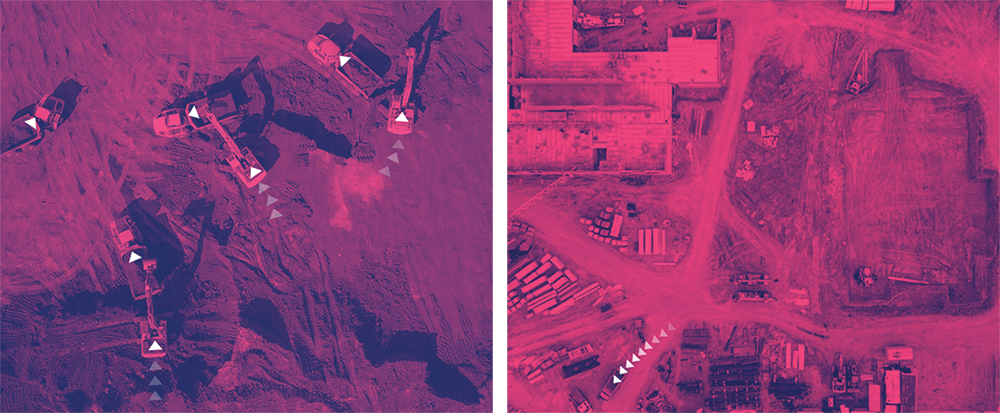
Industrial sites accelerate their operations with smarter vehicles, machines, and wearables. However, we have not seen much improvement in the overview monitoring that relies on operators’ experience and attention based on the information from video cameras and machine measurements that work separately. Many operators work in automated production and their primary responsibility is to be in charge and to react to any unwanted scenario.
Industrial sites still use video cameras to monitor production, the same cameras that have been around for a long time. All control rooms are covered by screens showing different parts of the production and activities combined with other measurement data. It is an overload of information and data types provided to the operator in charge. Smart video and AI are adopted less than in other industries, and the need for robustness sets high requirements for technical solutions, especially when introducing something new.
What is a volume change?
A LiDAR sensor constantly scans its environment with thousands of measurements that create a 3D model. This allows analysis in terms of volumes, shapes, and distances, compared to video analysis, for example. A volume change can be an increase or loss of volume, and it is also possible to filter objects based on the volume. A volume increase in a static scene means that new objects enter the scene and can be tracked. This feature supports tracking the most common objects, such as people and vehicles. Minor disturbances like birds, smaller animals, and vegetation can be filtered and removed.
Spills and other deviations during production can result in an increase in volume in areas that are typically supposed to be empty. On the other hand, volume loss can also occur, which can lead to various types of damage. Volume change analysis can be used to identify differences from the desired situation. It is also possible to set different rules for different areas, such as designating roads for vehicles and safe walking paths for people.
An increase in the volume is detected as an object that can be identified as a person, vehicle, etc., based on size and shape. When tracking an object, for example, a person, we can follow the person’s path and velocity. The velocity parameter can also identify dangerous situations caused by moving objects in the same environment. Since the LiDAR sensor sees in 3D, the distances between objects become natural and accurate. The safety of a site can be improved when every moving object is visible and can be followed without breaching integrity. Instead of equipping all vehicles with sensors and people with wearables, fewer sensors can monitor the entire vehicle fleet and all environmental activities and raise the alarm if potential danger is detected, e.g., collisions.
Wikipedia defines LiDAR as “light detection and ranging” or “laser imaging, detection, and ranging”. It is a method for determining ranges by targeting an object or a surface with a laser and measuring the time for the reflected light to return to the receiver. LiDAR may operate in a fixed direction (e.g., vertical) or scan in multiple directions, which is known as LiDAR scanning or 3D laser scanning, a special combination of 3-D and laser scanning. LiDAR has terrestrial, airborne, and mobile applications. (Source: https://en.wikipedia.org/wiki/Lidar.)
LiDAR solutions from EMS
Evolving Management Solutions (EMS) supplies a range of FlashEye LiDAR solutions suited to the mining industry. As mentioned above, LiDAR can monitor and manage traffic from heavy machinery, plus volume management.
FlashEye LiDAR creates 3D zones anywhere with automated control and self-diagnosis 24/7 without supervision, providing unaided decision-making that maintains control and allows no external influence.
LidarVolumes can create functionality zones to calculate volume, max/min levels of material (addition or loss detection of points), and object detection (human, vehicle, etc.). It creates a view for configuring the 3D zones and settings with alarm presentation and automatically integrating external interfaces, day or night and in a dust-laden atmosphere.
LidarConvey monitors:
• Material deviation.
• Top-size measurement.
• Human proximity detection.
• Volumetric flow.
Volumetric flow is managed by live feedback, automatically increasing or reducing the speed of the conveyor as loads change. A 10 cm per second increase in speed = 8.64 km of extra of volume.
CCTV images must be viewed live to create any control, as human interpretation can be wrong or operator intimidation can result in ‘agreed losses’, making decisions suspect with site losses unaffected.
LidarHaul can read loaded, empty, and partially loaded vehicles and decide on acceptance or rejection. It can provide remote control activation and monitoring through CCTV or lower barriers and call response teams for local intervention.
For more information, contact Evolving Management Solutions,
| Tel: | +27 11 274 6665 |
| Email: | [email protected], [email protected] |
| www: | www.emssa.net / www.commend.co.za |
| Articles: | More information and articles about Evolving Management Solutions |






© Technews Publishing (Pty) Ltd. | All Rights Reserved.
 printer friendly version