

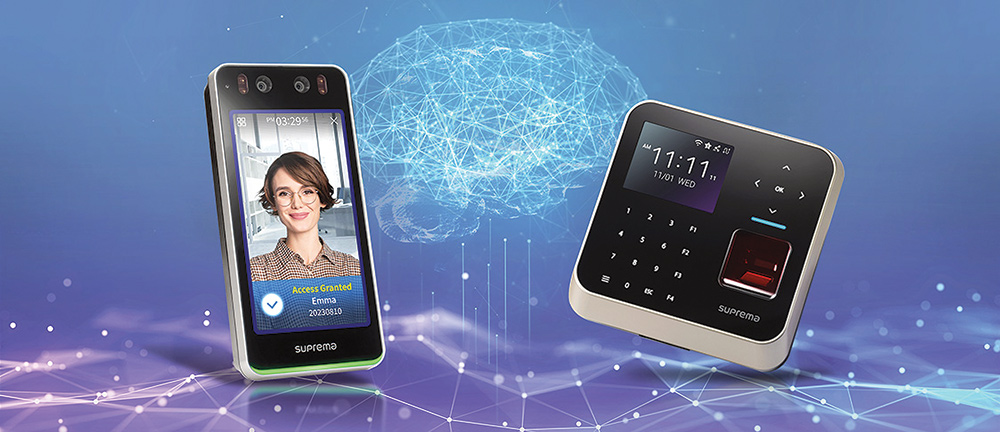
Unleash the full potential of AI at the edge

SMART Access & Identity 2024 AI & Data Analytics, Access Control & Identity Management

Edge devices are commonly used in access control systems because they are easy to install, scalable, and cost-efficient.

In the context of access control, edge devices are located near access points, such as doors or gates, to process authentication, manage access permissions, and make

real-time decisions at the point of entry. Edge devices are often preferred over traditional access control systems, where the permanent presence of a person is required to grant access. Edge devices are cost-effective, easy to install anywhere, and can scale up based on the organisation’s needs. Edge devices are widely used in various sites, from small and medium-sized businesses to enterprises where real-time 24/7 access control service is essential.

However, edge devices are small, low-power, and low-cost. As AI (artificial intelligence) adoption increases in the security industry, edge devices require more advanced hardware and software technologies to support the deployment of AI algorithms. Edge AI refers to deploying AI algorithms and running AI models directly on local edge devices. Therefore, optimising and streamlining AI algorithms for implementation on edge devices is crucial due to their limited resources, such as memory, storage, and processing power.

Running and training AI algorithms require vast datasets and high hardware specifications, as AI algorithms need to learn from large amounts of data and perform complex computations.

Feel the power of Suprema’s Edge AI, which runs NPU (Neural Processing Unit)-based AI algorithms on edge devices locally.

By integrating AI and edge computing, Suprema has developed high-performance edge AI devices. Suprema has adopted an advanced AI processor, NPU. The NPU is designed to execute AI algorithms with higher efficiency and performance compared to traditional GPU (Graphics Processing Unit). The NPU can process AI workloads faster while consuming less power, making it ideal for applications in edge devices and the security industry where real-time processing is crucial.

A standout feature of Suprema’s edge AI technology is its ability to create lightweight AI engines capable of efficiently handling vast datasets, while preventing overheating and slowdowns in hardware. Suprema’s optimised data processing model, known as the quantisation formula, plays a pivotal role in reducing both model size and operational quantity. This not only enhances model efficiency, but also bolsters hardware performance. The fingerprint recognition solution, BioStation 2a, and facial authentication solution, BioStation 3, can run AI algorithms and process authentication locally.
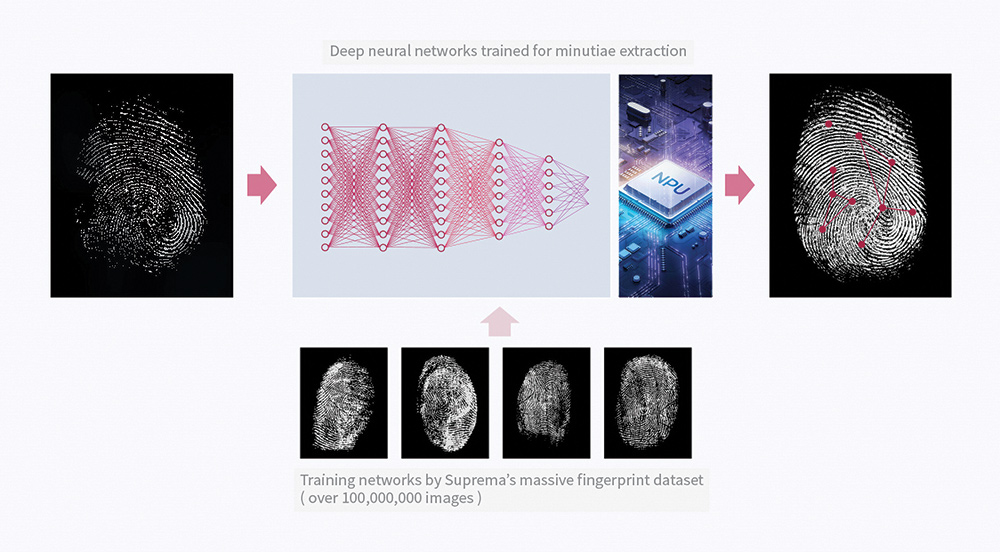
What sets Suprema apart is its capability to develop deep learning-based AI algorithms for biometric recognition.

AI integration proves particularly advantageous in biometric-based access control systems, where it analyses biometric data with higher precision. AI can identify distinctive patterns and features that might be difficult for traditional algorithms to discern, leading to improved recognition accuracy.

Additionally, AI can incorporate feedback from past errors to improve its algorithms, leading to better overall performance. Leveraging over two decades of extensive experience in the biometrics and access control industry, Suprema has the capacity to train on vast datasets for deep learning. Suprema stands out for its technical superiority in offering the most accurate and fast biometric recognition performance through data-driven, deep learning-based AI algorithms.


Credit(s)


Share this article:
Share via emailShare via LinkedInPrint this page


Further reading:

Banking’s AI reckoning
Financial (Industry) News & Events AI & Data Analytics
From agentic commerce disputes to quantum-powered risk modelling, SAS experts offer a ‘banker’s dozen,’ 13 industry-defining predictions that will separate institutions that master intelligent banking from those still struggling with the basics.

Read more...
2026 Industry Trends Report calls out security’s next opportunity
Integrated Solutions Access Control & Identity Management Perimeter Security, Alarms & Intruder Detection
Gallagher Security has released its 2026 Security Industry Trends Report, drawing on insights from end users, channel partners, consultants, and technology stakeholders; highlighting a growing opportunity for security to play a more strategic, value-driven role across organisations worldwide.

Read more...
Securing a South African healthcare network
Surveillance Healthcare (Industry) AI & Data Analytics
VIVOTEK partnered with local integrator Chase Networks and distributor Rectron to deliver a fully integrated security ecosystem, providing PathCare with a centralised view of all facilities, simplifying monitoring of sensitive laboratory areas, and ensuring SOP compliance.

Read more...
DeepAlert appoints Howard Harrison as CEO
DeepAlert News & Events AI & Data Analytics
DeepAlert has appointed Howard Harrison as chief executive officer. DeepAlert’s founder and CEO of the past six years, Dr Jasper Horrell, will transition into a newly created role as chief innovation officer.

Read more...
The year of the agent
Information Security AI & Data Analytics
The dominant attack patterns in Q4 2025 included system-prompt extraction attempts, subtle content-safety bypasses, and exploratory probing. Indirect attacks required fewer attempts than direct injections, making untrusted external sources a primary risk vector heading into 2026.

Read more...
AI agent suite for control rooms
Milestone Systems News & Events Surveillance AI & Data Analytics
Visionplatform.ai announced the public launch of its new visionplatform.ai Agent Suite for Milestone XProtect, adding reasoning, context and assisted decision-making on top of existing video analytics and events — without sending video to the cloud.

Read more...
AI cybersecurity predictions for 2026
AI & Data Analytics Information Security
The rapid development of AI is reshaping the cybersecurity landscape in 2026, for both individual users and businesses. Large language models (LLMs) are influencing defensive capabilities while simultaneously expanding opportunities for threat actors.

Read more...
The year of machine deception
Security Services & Risk Management AI & Data Analytics
The AU10TIX Global Fraud Report, Signals for 2026, warns of the looming agentic AI and quantum risk, leading to a surge in adaptive, self-learning fraud, and outlines how early warning systems are fighting back.

Read more...
Smarter access, stronger defence
Secutel Technologies Security Services & Risk Management Access Control & Identity Management Retail (Industry)
The holiday season brings excitement, increased foot traffic and, unfortunately, a spike in criminal activity targeting retail environments. Taking a proactive approach to security is essential in ensuring staff and assets remain safe.

Read more...
Dahua showcases smart city solutions
AI & Data Analytics Fire & Safety IoT & Automation
Dahua showcased its smart city solutions at the Smart City Expo World Congress in Barcelona, Spain, which brought together experts, innovators, and city leaders from around the globe to explore the future of urban transformation.

Read more...


While every effort has been made to ensure the accuracy of the information contained herein, the publisher and its agents cannot be held responsible for any errors contained, or any loss incurred as a result. Articles published do not necessarily reflect the views of the publishers. The editor reserves the right to alter or cut copy. Articles submitted are deemed to have been cleared for publication. Advertisements and company contact details are published as provided by the advertiser. Technews Publishing (Pty) Ltd cannot be held responsible for the accuracy or veracity of supplied material.


© Technews Publishing (Pty) Ltd. | All Rights Reserved.

