

Post-pandemic access control features

Issue 7 2022 Access Control & Identity Management, Products & Solutions, Commercial (Industry)

Paxton launched COVID-specific features as a result of the pandemic for its Net2 and Paxton10 security systems. These features were well received at the time and continue to have real-world uses that can benefit building managers internationally.

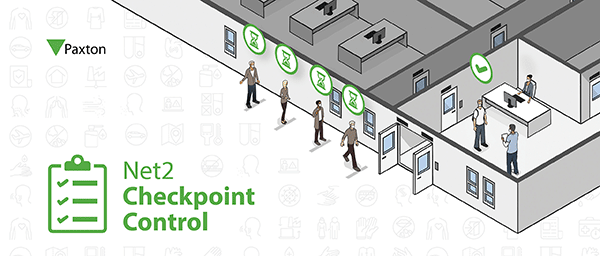
Paxton introduced occupancy management and checkpoint control for its Net2 access control system in 2020. Both features support the managing of people flow around a building to reduce the risk of viral spread in a populated area.

Occupancy management allows facility managers to limit the number of people in a selected area; by either barring access or sending a notification to the building manager when a space nears full capacity. Checkpoint control can help users remain in a place before being granted access through a checkpoint. The features can integrate with thermal scanning hardware to identify whether an individual has a high temperature.

Steve Rowlands, Paxton’s divisional director of product management, explains: “These features are still useful now that social restrictions are behind us. Occupancy management can integrate with triggers and actions for an automated experience. Using the features together, the system can automatically trigger an action when the occupancy level reaches a set number – for example, to turn off an appliance such as lights or air conditioning when the occupancy level reaches zero in a designated area.

“Checkpoint control allows site managers to verify a visitor’s or employee’s identity before granting access. This is an efficient feature to restrict access at a reception area or building entrance. This can help ensure safety of the people and assets at a building.”

Paxton Key

The Paxton Key app for Paxton10 is another product that was useful during the pandemic. It allows site managers to send visitors access permissions to a building virtually, within seconds. The users can use their smartphones or smartwatches as electronic tokens, which Paxton refers to as smart credentials. This means that in-person contact is not necessary, and it can limit the number of touchpoints when navigating a site.

Rowlands says: “Paxton Key is a feature of Paxton10 and suits the needs of building managers and users in a modern environment. The free Bluetooth smart credentials in Paxton10 can replace electronic tokens or traditional keys, which can help keep germs at bay and save costs if the site expands or needs to change locks.”


Credit(s)


Share this article:
Share via emailShare via LinkedInPrint this page


Further reading:

Verification is reshaping South Africa’s labour market
Security Services & Risk Management Asset Management Commercial (Industry)
Hiring faster, trusting less: in a labour market defined by both constraint and potential, the ability to hire with confidence may well become one of the most important competitive advantages.

Read more...
Paxton set to launch game-changing new system
Paxton Access Control & Identity Management News & Events
Access control is evolving fast. Installers and end users are looking for systems that are simple to install, easy to manage remotely, and flexible enough to scale. In response, Paxton is exploring how emerging technologies can reshape access control.

Read more...
SWEAR integrates with Milestone
Milestone Systems Surveillance Products & Solutions
Security footage, legal evidence, and other critical surveillance assets face increasing risks of tampering, raising chain-of-custody questions, jeopardising admissibility, and undermining the timely operational decisions that depend on credible video.

Read more...
Africa’s largest Zero Trust platform
NEC XON Information Security Commercial (Industry)
Africa has reached a significant cybersecurity milestone with the successful deployment of the continent’s largest Palo Alto Networks Prisma Access and Prisma Access Browser Zero Trust environment, supporting secure remote access for more than 40 000 users for a large enterprise in Africa.

Read more...
NEC XON secures mobile provider’s hybrid identities
NEC XON Access Control & Identity Management Information Security Commercial (Industry)
For a leading South African telecommunications operator, identity protection has become a strategic priority as identity-centric attacks proliferate across the industry. The company faced mounting pressure to secure both human and non-human identities across complex hybrid environments.

Read more...
Cloud security in visitor management and access control
SA Technologies Access Control & Identity Management Infrastructure Residential Estate (Industry) Commercial (Industry)
Cloud has become the default platform for modern security operations, from visitor management portals and remote access control to incident logging, reporting, analytics, and integrations. But “in the cloud” does not mean “someone else is securing it for us”.

Read more...
Centurion raises the bar at HomeSec Expo
Centurion Systems News & Events Access Control & Identity Management Residential Estate (Industry) Smart Home Automation Commercial (Industry)
Centurion Systems unveiled its latest product lines at HomeSec Expo 2026, introducing SMART+, a simpler way for installers and end users to manage their Centurion installations - as well as a few new products.

Read more...
Bringing fire safety closer to home
SafeQuip Fire & Safety Products & Solutions Smart Home Automation
SafeQuip’s latest product launch introduces two compact, disposable fire extinguishers for everyday use, one suitable for Class A, B, and C fires, the other rated for Class A, B and F fires.

Read more...
What’s in store for PAM and IAM?
Access Control & Identity Management Information Security
Leostream predicts changes in Identity and Access Management (IAM) and Privileged Access Management (PAM) in the coming year, driven by evolving cybersecurity realities, hybridisation, AI, and more.

Read more...
Protecting citizens’ identities: a shared responsibility
Access Control & Identity Management
A blind spot in identity authentication today is still physical identity documents. Identity cards, passports, and driver’s licences, biometric or not, are broken, forged, or misused, fueling global trafficking networks and undermining public trust in institutions.

Read more...


While every effort has been made to ensure the accuracy of the information contained herein, the publisher and its agents cannot be held responsible for any errors contained, or any loss incurred as a result. Articles published do not necessarily reflect the views of the publishers. The editor reserves the right to alter or cut copy. Articles submitted are deemed to have been cleared for publication. Advertisements and company contact details are published as provided by the advertiser. Technews Publishing (Pty) Ltd cannot be held responsible for the accuracy or veracity of supplied material.


© Technews Publishing (Pty) Ltd. | All Rights Reserved.

