


On the 9th of July 2021, South Africans woke up to images that resembled something out of the apocalypse, not real life. During the eight days of rioting and looting, 354 people lost their lives, an estimated R16 billion in damages were caused and 45 000 businesses were affected.
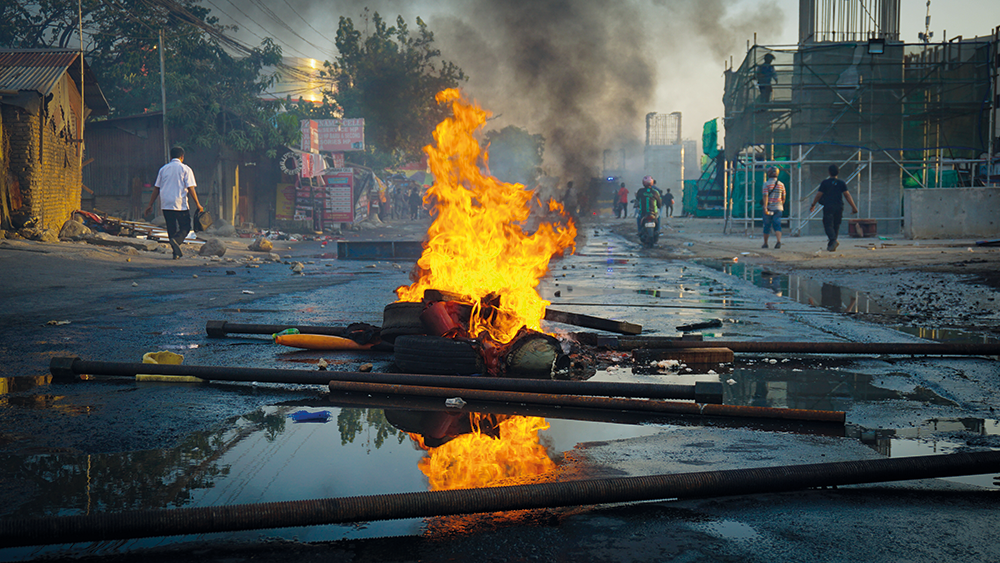
As a company we were the hardest hit and the first to have a store burned out. At the end of the eight days, we had 283 stores looted and 39 completely destroyed, equating to almost 10% of our total trading space. By December, however, we had reopened 236 stores to serve our remarkable customers in time for Christmas and the ‘Back to School’ period.

Not only did the efforts of our department help to enable the business to provide essential goods and services in record time to our customers, but also job security to over 4000 employees and profit growth to our shareholders. Acting early on information in the weeks leading up to July, we had prepared our logistic network for a situation taking place and our 20 distribution centres and hubs were left unscathed.
Being forewarned prevented management from being overwhelmed by the events taking place on the ground and the team could focus on getting the business ready to reopen by securing materials to secure and rebuild our stores.
Critical to our success was the ability to collect relevant data, analyse the data to create intelligence and communicate the intelligence in a way to stakeholders, for them to make decisions and take decisive actions. Information management for us, as it is for everyone, is the pivot of Crisis Management and Response.
Information exchange management
The single most important function of any crisis management operation and the single most common cause of failure, is the ability to manage the flow of information. Timely and actionable intelligence can quickly build a trust relationship between the Crisis Response Team and decision makers, but the opposite is also true. Delayed and inaccurate information quickly erodes the trust of stakeholders that can paralyse the crisis response effort. Anything that creates blockages, delays or confusion within this process is likely to have a major and significant impact on the final outcome.
The problem in a crisis is not that there is not enough information, but that there is an overload of information, much of which will be contradictory and all of which needs to be assessed and judged as to its veracity, its relevance and its place in the overall picture.

A crisis by its very definition will fall outside standard response and planned scenarios. Crisis Management Teams need to function under immense time pressure in an environment with constant threat escalation and quite often a lack of verified information. On top of that there is a constant need to transfer complex information under pressure between multiple stakeholders who need to make decisions, the lack of which could lead to catastrophic consequences.
The best tools to use in a crisis situation are the systems that are already available and familiar to everyone in the process. For us as a team, free instant messaging apps were critical to the teams in collecting, verifying and distributing information. The information was then easily compiled in a dashboard in a spreadsheet for the team to use and stakeholders to have a live view of changing events. (A template of the dashboard can be found at
Your dashboard ideally needs to consist of the following aspects
1. Fact pattern
All information should be captured as and when it becomes available, to be verified by an eyewitness where possible. The minimum information of What, Where, When an event happened and Who reported is a good baseline of information.
2. Decision making
Crisis decision making is emergent not planned. Once the information has been verified and the real facts or problem is known, an effort can be made to anticipate consequences and solutions. Having a dynamic live dashboard enables a large number of people to come up with varied solutions looking at the same problem. Participants should also be encouraged to not only look at potential risk, but also any potential opportunities. A positive frame of mind goes a long way when days get long and situations darker.
3. Priorities
Solutions then need to be prioritised and delegated to a responsible person who needs to take ownership of the problem. It also helps to have specific deadlines to work towards and keep track of tasks that have been delegated.
4. Implementation
In the midst of the crisis the Crisis Response Team needs to be responsive and support operational teams on the ground, not direct them. As the crisis progresses and the overall picture becomes clearer, the Crisis Response Team can take a more active role in managing the sum of all the parts. Once priorities have been identified, the remedial actions can be categorised as: Immediate Actions; Delayed; Deferred; Omitted and Completed. Particularly in the beginning of the crisis, small victories should be celebrated. Being able to see even the small steps has a big impact on the morale of the Crisis Response Team and stakeholders alike.
5. De-escalation/re-escalation
Ultimately the aim is not to manage the crisis, but manage the organisation through a crisis. As soon as the situation warrants it, the de-escalation of the response should start and be suitably managed. There is often a threat of re-escalation during the crisis and sufficient resources should be kept in place until the crisis has passed.
Good record-keeping also adds great value in the after-action review. (What was done well, what could have been done better). Should there be a need to testify to a committee or a court, the information is precise and readily available to show the workings of the organisation during the crisis.
Information is worthless if it doesn’t lead to actions
“Real crisis management does not start when a crisis is discovered, but is an embodied value intrinsic to every aspect of an effective organisation’s operations. Risk attitude and culture will have the greatest impact on the ability of the organisation to identify potential crises at the earliest opportunity, to respond in a timely and appropriate manner and to embody the concepts of organisational resilience.” - Dr David Rubens, 2020, Institute of Strategic Risk Management.
The real loss of the July unrest would be if we don’t take the opportunity to learn from the event and improve our preparation and response. In a world of uncertainty, we can be certain of one thing, that there is a crisis over the horizon waiting for us. Take action now. Build mutually beneficial relationships, get consensus on working methods, but above all, ensure that you have a strategy and a structure in place to manage the exchange of information.
Adriaan Bosch is a member of ASIS SA. For more information on ASIS, go to www.asissa.co.za






© Technews Publishing (Pty) Ltd. | All Rights Reserved.
 printer friendly version