Global employment specialists, WorkMotion.com, have released a study that analyses the ease of complying with local employment laws and ranks the attractiveness of 80 global cities for remote workers. As a company that helps companies hire employees based anywhere in the world, WorkMotion decided to rank the cities according to their remote working compliance regulations, cost of living, infrastructure and liveability.
Additionally, they used proprietary data to illustrate current location trends by showing where remote workers are currently being hired from. The resulting index reveals which cities are facilitating remote working best and which are most attractive for remote workers to relocate to, as well as current remote worker patterns.
How the study was conducted
WorkMotion began the study by identifying a list of indicators that impact whether a city is a good place for relocation, covering employment compliance regulations, infrastructure, costs and liveability. They then assessed thousands of global cities against a range of factors related to remote working, before selecting the best scoring 80 cities.
For the first category, Remote Working Compliance, they assessed how straightforward it is for companies to compliantly hire remote workers based on local legislation, in addition to the legal requirements they must adhere to when employing a remote worker. They also identified whether the locations in the study offered a specific visa for remote workers.
Next, the researchers analysed the cost of living in each city by studying local tax rates, housing costs and availability and how affordable the city is for food, energy and other living expenses. Following this, they moved on to review each city’s civic infrastructure by assessing the levels of political stability, gender equality, minority equality and LGBT+ equality. The cities’ level of safety and security was also evaluated, in addition to the quality of the public education system, health system and the access citizens have to healthcare.
To conclude the research, they assessed each city’s liveability by looking at the quality and variety of the cultural attractions on offer, the cost and quality of the mobility and data on citizens’ happiness. The resulting study provides an assessment of the current remote working landscape by ranking 80 global cities for their accessibility and attractiveness for this demographic.
The full table of data, sources and complete methodology is at https://workmotion.com/best-remote-work-cities, (or use the short URL www.securitysa.com/*WM1).
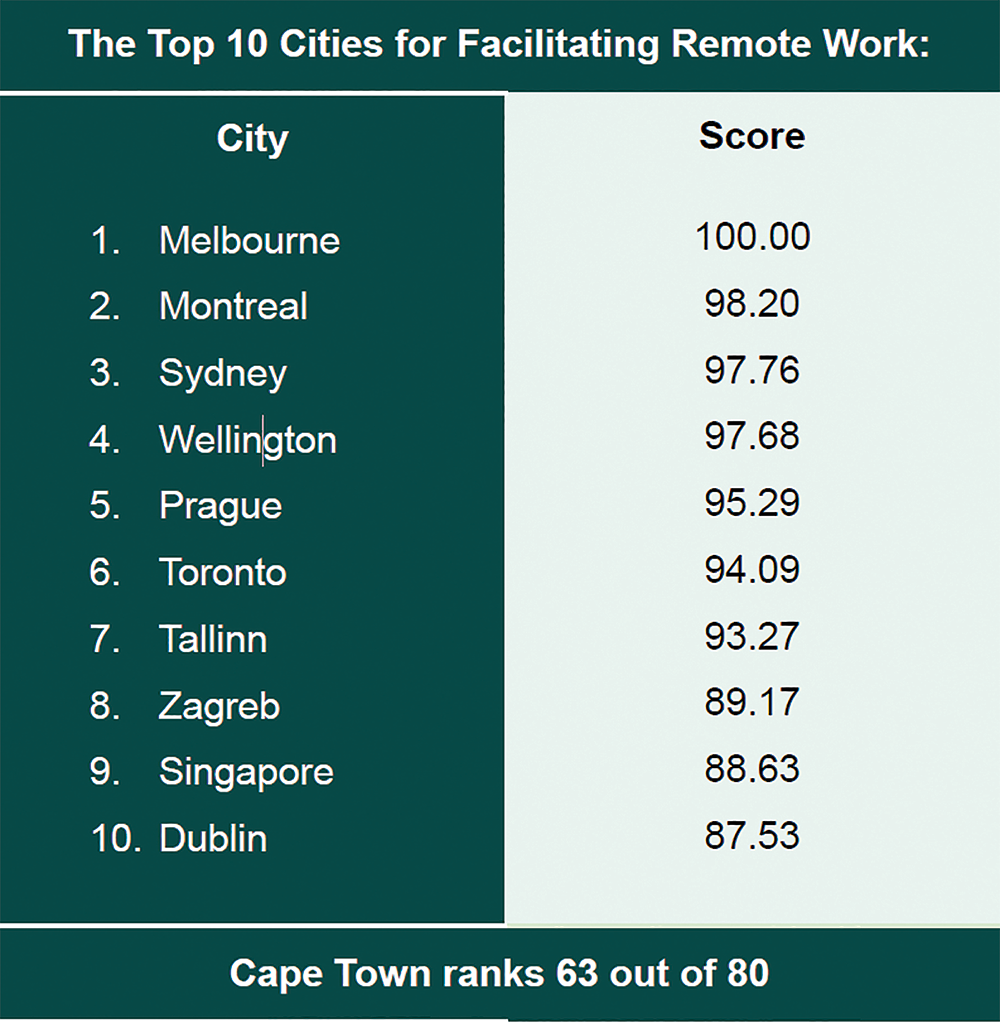
Table 1 reveals a sample of results for the top 10 cities for facilitating remote work out of the 80 cities in the index. All scores are out of 100, with 100 being the highest possible score and 50 being the lowest.
“Although we had long anticipated the move to remote working and set up WorkMotion with this in mind, the pandemic has hastened the trend far faster than we could have imagined,” comments Carsten Lebtig, co-founder and managing director of WorkMotion. “The technology for remote work was well-established and in use prior to the pandemic; what has changed in the intervening period is the mindset companies have towards remote working.
“Nowadays, many people working in office jobs enjoy flexi-working and split their time between their home and office, with little or no effect on productivity levels. Some companies, meanwhile, have been able to reduce the size of their offices, cutting expenses in doing so. Now that the dust is settling, many companies are beginning to look further afield when hiring employees, comfortable with the idea that the best person for the job might be located in a different country. The study gives insight into which countries have the most straightforward regulations when hiring remote workers.”
He adds, “When identifying possible destinations for relocation, remote workers must consider a range of factors ranging from the practical to the desirable. Not many cities can offer them all, but it’s undeniable that cities legislating to attract remote workers become far more attractive than those that don’t. Making it easier for employees to work remotely in their city by offering this demographic specific visas means the relocation process becomes far smoother.
“Only 11 cities in the study offer a digital nomad visa, which is a specific document that allows remote workers to continue their employment in the country of relocation, demonstrating that the majority of cities still lag behind in this area. We expect to see this change over the next few years, as remote working becomes more common and cities begin to recognise the benefits it can bring.”
A breakdown of the results can be found at https://workmotion.com/best-remote-work-cities, (short URL: www.securitysa.com/*WM1).
This article has been shortened, the full article (focused on Cape Town) can be found at www.securitysa.com/*WM2.






© Technews Publishing (Pty) Ltd. | All Rights Reserved.
 printer friendly version