

Jian: The double-edged cyber sword

Issue 1 2021 Editor's Choice, Information Security

In the last few months, Check Point Research (CPR) focused on recent Windows Local Privilege Escalation (LPE) exploits attributed to Chinese actors. An LPE is used by attackers to acquire administrator rights on a Windows machine. During this investigation, our malware and vulnerability researchers managed to unravel the hidden story and origins behind ’Jian‘, an exploit that was previously attributed to the Chinese-affiliated attack group named APT31 (Zirconium). The attack tool was caught and reported to Microsoft by Lockheed Martin’s Computer Incident Response Team, suggesting a possible attack against an American target.
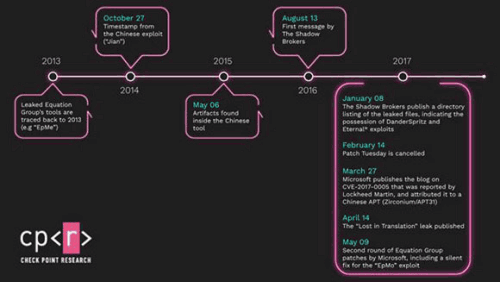
For the sake of brevity, we dubbed APT31’s exploit Jian. During this investigation, our researchers managed to unravel the hidden story behind Jian, which translates to a double-edged straight sword used in China. The Jian exploit was previously attributed to APT31 (Zirconium), and we’ve now discovered its true origins.

Our research shows that CVE-2017-0005, a Windows LPE vulnerability that was attributed to a Chinese APT, was replicated based on an Equation Group exploit for the same vulnerability that the APT had access to. EpMe, the Equation Group exploit for CVE-2017-0005, is one of four different LPE exploits included in the DanderSpritz attack framework. DanderSpritz is Equation Group's post-exploitation framework that contains a wide variety of tools for persistence, reconnaissance, lateral movement, bypassing antivirus engines, and more. EpMe dates back to at least 2013, which is four years before APT31 was caught exploiting the vulnerability in the wild.

In our technical blog, we introduce the four different Windows LPE exploits included in the DanderSpritz framework, revealing an additional exploit codenamed EpMo. EpMo, one of the exploits in the framework, was never publicly discussed and the unknown vulnerability it targets was patched by Microsoft in May 2017 with no apparent announcement. The patch could potentially be associated with the after-effects of the Shadow Brokers leak (https://blog.checkpoint.com/2017/05/25/brokers-shadows-analyzing-vulnerabilities-attacks-spawned-leaked-nsa-hacking-tools/) of Equation Group tools. While the vulnerability was fixed, we couldn’t identify the official vulnerability ID (CVE-ID) associated with it, and to our knowledge, this is the first public mention of the existence of this additional Equation Group vulnerability.

Read the full technical story at https://research.checkpoint.com/2021/the-story-of-jian


Share this article:
Share via emailShare via LinkedInPrint this page


Further reading:

Rise in malicious insider threat reports
News & Events Information Security
Mimecast Study finds 46% of SA organisations report a rise in malicious insider threat reports over the past year: reveals disconnect between security awareness and technical controls as AI-powered attacks accelerate.

Read more...
Surveillance & AI roundtable
DeepAlert Lytehouse Refraime SMART Security Solutions Technews Publishing Editor's Choice Surveillance Integrated Solutions AI & Data Analytics
SMART Security Solutions held an online roundtable with a few surveillance experts to explore the intersection of surveillance and AI, gaining insights into the market and how control rooms are evolving.

Read more...
New campaign exploiting Google Tasks notifications
News & Events Information Security
New phishing scheme abuses legitimate Google Tasks notifications to trick corporate users into revealing corporate login credentials, which can then be used to gain unauthorised access to company systems, steal data, or launch further attacks.

Read more...
What’s in store for PAM and IAM?
Access Control & Identity Management Information Security
Leostream predicts changes in Identity and Access Management (IAM) and Privileged Access Management (PAM) in the coming year, driven by evolving cybersecurity realities, hybridisation, AI, and more.

Read more...
The challenges of cybersecurity in access control
Technews Publishing SMART Security Solutions Access Control & Identity Management Information Security
SMART Security Solutions summarises the key points dealing with modern cyber risks facing access control systems, from Mercury Security’s white paper “Meeting the Challenges of Cybersecurity in Access Control: A Future-Ready Approach.”

Read more...
Securing your access hardware and software
SMART Security Solutions Technews Publishing RBH Access Technologies Access Control & Identity Management Information Security
Securing access control technology is critical for physical and digital security. Every interaction between readers, controllers, and host systems creates a potential attack point for those with nefarious intent.

Read more...
Phishing and social engineering are the most significant risks
News & Events Information Security
ESET Research found that phishing accounted for 45,7% of all detected cyberthreats in South Africa, with higher-quality deepfakes, signs of AI-generated phishing websites, and short-lived advertising campaigns designed to evade detection.

Read more...
Access trends for 2026
Technews Publishing SMART Security Solutions RR Electronic Security Solutions Enkulu Technologies IDEMIA neaMetrics Editor's Choice Access Control & Identity Management Infrastructure
The access control and identity management industry has been the cornerstone of organisations of all sizes for decades. SMART Security Solutions asked local integrators and distributors about the primary trends in the access and identity market for 2026.

Read more...
Access data for business efficiency
Continuum Identity Editor's Choice Access Control & Identity Management AI & Data Analytics Facilities & Building Management
In all organisations, access systems are paramount to securing people, data, places, goods, and resources. Today, hybrid systems deliver significant added value to users at a much lower cost.

Read more...
Zero Trust access control
Technews Publishing SMART Security Solutions CASA Software NEC XON Editor's Choice Access Control & Identity Management Information Security
Zero Trust Architecture enforces the rule of ‘never trust, always verify’. It changes an organisation’s security posture by assuming that threats exist both inside and outside the perimeter, and it applies to information and physical security.

Read more...


While every effort has been made to ensure the accuracy of the information contained herein, the publisher and its agents cannot be held responsible for any errors contained, or any loss incurred as a result. Articles published do not necessarily reflect the views of the publishers. The editor reserves the right to alter or cut copy. Articles submitted are deemed to have been cleared for publication. Advertisements and company contact details are published as provided by the advertiser. Technews Publishing (Pty) Ltd cannot be held responsible for the accuracy or veracity of supplied material.


© Technews Publishing (Pty) Ltd. | All Rights Reserved.

