


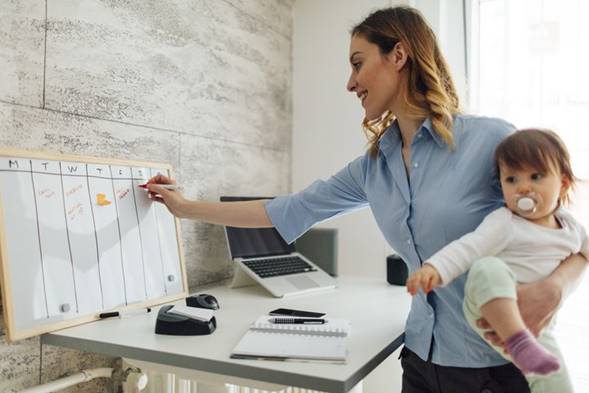
In the blink of an eye, remote work went from an experiment to a requirement. And as the results of a recent survey conducted by OnePoll on behalf of Citrix Systems revealed, work has a completely new look as employees around the world adapt to the realities or working from home. Beds have become desks, bathrooms serve as conference rooms, kids and pets crash virtual meetings and cameras thought to be off capture awkward moments and sounds. Yet, workers remain as, if not more productive and engaged.
The new normal is not normal
Remote work has become the new normal. But for most employees, it is anything but. “It’s interesting, funny and novel to see your co-workers in their pyjamas on a video call,” says Donna Kimmel, executive vice president and chief people officer, Citrix. “But for remote work to work, employees need to get into a repeatable rhythm so they can be and do their best wherever they happen to be.”
A new routine
With their daily commutes reduced from hours to minutes, the majority of the 2000 US workers who participated in the OnePoll research – comprised of office workers currently working from home due to the coronavirus outbreak – are adapting their daily routines. While 24% get up at the same time as they did when commuting to an office, the vast majority say they are working around a new clock:
• 25% sleep in a little more.
• 22% sleep until the last possible moment they need to be online.
They’ve also adjusted their personal routines and spend less time getting ready for work:
• 34% shower every day.
• 26% continue to do hair/makeup/other grooming.
• 15% shave less.
And 25% of respondents say they can focus and get work done more quickly as a result.
Ready or not, here it comes
Few employees were ready for the abrupt shift to remote work that the coronavirus pandemic has forced. And while 82% of those who participated in the OnePoll survey said their companies were ‘completely’ or ‘fairly’ ready and had the technology and infrastructure in place to enable it on short notice, they cited a number of issues that make working from home tough:
• Strict security protocols and lack of single sign-on, requiring multiple passwords and two-factor authentication to access apps (33%).
• Slow home broadband/Wi-Fi (33%).
• Lack of access to all the apps needed to get work done (23%).
• Slow virtual private network (VPN) connection (16%).
The home as office
When it comes to remote work, technology is only a piece of the work-from-home puzzle. “In addition to providing a digital work space that has all of the tools and data a person needs, it’s essential to create a physical one that fits individual work styles,” Kimmel says. And the OnePoll data shows employees are getting creative in doing so, as most are sharing space with others who have also been forced to work or learn from home. In addition, 14% of office workers reported temporarily working from their second/vacation home, 13% at their parents’ or in-laws’ house and 5% are even sheltering in a hotel.
“I love seeing a formerly office-bound executive dive into a call in the kitchen — with shower hair, kids in the background, yet their razor-sharp savvy and perspective intact,” says Meghan M. Biro, founder of Talent Culture. “It’s fun to watch people be surprised by their own grit and resourcefulness. It’s also fun to keep it real. It takes some of the edge off our tremendous anxieties right now.”
But it can also lead to some awkward moments. Roughly 44% of workers have signed on to video meetings and not realised their cameras were on. Many have also experienced embarrassing moments thinking they were on mute when their microphones were actually on.
What does working from home look like?
• 29% of those polled wear slippers or no shoes.
• 28% get dressed in the same attire they would wear to the office.
• 25% wear sweatpants or pyjamas.
• 25% get half-dressed so they can “look nice on video conferences”.
• 24% wear workout clothes.
The future of work?
And will it persist once the pandemic subsides?
• 37% of employees surveyed think their organisations will be more relaxed about working from home and 32% say they plan to do so more often.
• 33% are eager to return to the office.
• 28% indicated they will actively look for a new job that allows them to permanently work remotely.
Read the full results at https://www.citrix.com/content/dam/citrix61/en_us/images/offsite/one-poll-citrix-knowledge-workers.pdf






© Technews Publishing (Pty) Ltd. | All Rights Reserved.
 printer friendly version