

An effective anti-botnet solution for ISPs

November 2011 Information Security

With Internet Service Providers (ISPs) worldwide facing a serious challenge from malicious, organised networks of computers — or botnets – a new anti-botnet solution has been launched.

Botnets operate within a network, using a service provider’s infrastructure to distribute massive quantities of spam. Botnets are responsible for the distribution of up to 90% of the world’s spam and strike at a service provider’s core business assets: IP addresses, bandwidth and service reputation.

Despite ongoing closures of Botnets worldwide, spam continues to flow at an ever-increasing rate throughout the world. This activity is easily transportable and the potential profits mean that Botnets will continue to be a significant reality in the world of organised crime. As global broadband penetration rates increase and mobile/smartphone technologies become more accessible, ISPs and telcos face the increasingly complex challenge of providing reliable, efficient internet services.

In response, PineApp, a network security solution provider has released a carrier-grade solution able to scan and block unwanted or malicious outbound e-mail traffic. Easy to deploy, the PineApp Outbound Spam Guard (OSG) functions as a transparent proxy that communicates to the ISP— in real time and with granular level statistics — details of the IP addresses within their networks that are infected and being controlled by botnets. The company claims it can stop 99% of spam messages.
“By harnessing the power of PineApp’s OSG, an ISP can reduce blacklisted IPs, improve IP reputation and reduce unwanted consumption of bandwidth,” says Hilton Loewenstein of SeKure-IT, southern African distributors of PineApp solutions. “The OSG has already been deployed in ISP networks across Africa and Asia, with beyond-expectation success. A recent installation at an ISP in Thailand with over 1,2 million IP addresses is just one of the latest success stories illustrating how the OSG is addressing the Botnet scourge.

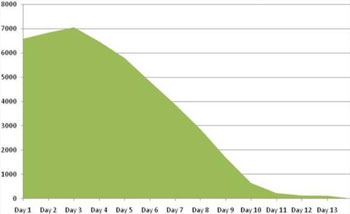
“This ISP was suffering from a major infestation that was leading to thousands of blacklisted IP addresses. Within 14 days of implementation, the OSG blocked up to 97% of all outbound e-mails – meaning that 97% of the ISP’s e-mail traffic was spam. Even more importantly, during that 14-day implementation period, the number of blacklisted IP’s was reduced to an almost insignificant amount. The OSG quickly and effectively secured the ISP’s infrastructure and customer e-mail-related complaints plummeted in just two weeks,” says Loewenstein.

The graph below shows the actual number of blacklisted IP’s reduced within 14 days of implementation.

“The PineApp OSG technology has been developed to address the requirements of the world’s largest ISPs and is capable of processing more than 40 million e-mail sessions per hour. Without compromising service continuity or quality, the OSG successfully blocks 99%, or more, of all unwanted outgoing e-mail messages,” concludes Loewenstein.

For more information, contact Hilton Loewenstein at SeKure-IT, on +27 (0)11 609 9495.


Share this article:
Share via emailShare via LinkedInPrint this page


Further reading:

71% of organisations suffered an identity breach
News & Events Information Security
The State of Identity Security 2026 report from Sophos finds human error and poor non-human identity management are the root causes of most attacks, as agentic AI accelerates the risk.

Read more...
Cyber resilience is the real defence
Security Services & Risk Management Information Security Infrastructure
Cyber resilience has evolved into a form of strategic agility, ensuring that when an interruption occurs, the business does not just survive; it snaps back into place before the market even notices a pause.

Read more...
You will not get your files back with VECT
Information Security
If the newbie to the ransomware scene, VECT, comes knocking at your organisation’s door, do not pay the ransom! The decryption keys simply do not exist. They were discarded at the moment of encryption by the malware itself.

Read more...
Industrial sector is a primary cyber target
Information Security
Threats in industrial environments are distributed with striking uniformity: APT-driven incidents constitute 17,8%, malware 14,9% and social engineering 13,9%. This pattern suggests that industrial organisations attract a broad range of adversaries with different capabilities and objectives.

Read more...
Key attributes of an effective cybersecurity leader
BlueVision Information Security
In an evolving technology landscape, an effective cyber leader must combine technical acumen, foresight, and adaptive leadership to mitigate risks, and risks can only be mitigated once accurately identified and remedial processes are in place.

Read more...
Employees are SA’s biggest cyber threat
Security Services & Risk Management Information Security
South Africa experienced a 46% increase in insider cyber risk in 2026, surpassing the global average of 44%. What is more, 63% of South African companies surveyed expect insider-driven data losses to increase.

Read more...
Surge in AI-enabled cybercrime and a 389% increase in ransomware
News & Events Information Security
Cybercrime no longer functions as a series of isolated campaigns; it operates as a system, with malicious hackers operating across an end-to-end life cycle and compressing the attack life cycle with shadow agents.

Read more...
Tackling enterprise security ‘tool sprawl’
NEC XON Information Security
South African ICT solutions provider NEC XON is advocating a shift away from fragmented cybersecurity toolsets towards unified platforms, arguing that ‘tool sprawl’ is undermining the effectiveness of enterprise security operations.

Read more...
SilverFox campaign targeting companies in South Africa
Information Security News & Events
The APT campaign involved disguising malicious files as documents related to tax violations. Upon infection, attackers could gain remote access to affected devices and exfiltrate sensitive organisational data.

Read more...
Q-Day is closer than you think
Information Security
The accelerated 2029 quantum computing deadline turns current encryption into a looming crisis as Google brings its internal post-quantum cryptography migration deadline forward to 2029.

Read more...


While every effort has been made to ensure the accuracy of the information contained herein, the publisher and its agents cannot be held responsible for any errors contained, or any loss incurred as a result. Articles published do not necessarily reflect the views of the publishers. The editor reserves the right to alter or cut copy. Articles submitted are deemed to have been cleared for publication. Advertisements and company contact details are published as provided by the advertiser. Technews Publishing (Pty) Ltd cannot be held responsible for the accuracy or veracity of supplied material.


© Technews Publishing (Pty) Ltd. | All Rights Reserved.

