


Breaches of security are minimised in many ways. One way is to literally limit the windows of opportunity for infringement. For instance, if the database of those authorised for access to a facility is not reliant on networking hardware systems, the chance for someone to infiltrate the system is reduced as are the possibilities of downtime. One cannot hack what is not there. What is not there cannot break down.
That is what embedded biometrics add to a system. When biometrics are embedded, no PC nor other IT elements are involved in managing the database at the door. In some instances, this level of integration can be achieved without reporting to an external access control system.
If one is not authorised to enter, the reader at the location, without checking elsewhere, tells that person that they cannot enter. Likewise, if authorised, that person can enter without the reader having to verify from a remote location.
Embedded systems come in two different varieties. One has been used for some time and is seldom even thought of as an embedded system. It is the standalone biometric reader, which manages biometric templates within the reader. The other is newer, where the biometric template management is actually performed by a smartcard.
Standalone biometric systems have been employed since the late 1980s. The Recognition Systems HandKey II reader providing access to a unique private library and museum at the New York Weill Cornell Medical Center is a case in point. The museum is so secure that it is only accessible to a very small group of people.
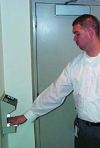
"It was imperative that access be secured because of the value of our library and the museum's contents," explains Ben Scaglione, director of security at New York Weill Cornell Medical Center, which along with Columbia Presbyterian, makes up New York Presbyterian Hospital, one of the most comprehensive university hospitals in the world. "People come from all over the world to review and look at the books and artifacts located here."
According to Scaglione, New York Weill Cornell has a magnetic stripe system for the rest of the facility. However, the museum presented a special problem, needing something extremely reliable and foolproof. Instead of verifying a card or code, the HandKey reader verifies the person who is at the entrance. The exclusive users simply enter their unique ID numbers on the HandKey's keypad and present their hands to gain entry. No other equipment or system is involved.
Smartcards, embedded biometrics in your wallet
What is being installed at major seaports is but one example of how a smartcard can store both the user's ID number and hand geometry template on the card. Because of this, there is no need to distribute hand templates across a network of hand readers or require the access control system to manage biometric templates. This means integration to any existing access control application is greatly simplified and additional network infrastructure costs are eliminated. Since the template only resides on the card, the solution also eases individual privacy concerns.
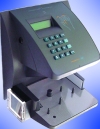
Providing the best of smartcards and biometrics, the solution provides dual authentication by requesting both the right card and the right person. A smartcard reader is embedded into the biometric reader. A plastic cardholder is affixed to the side of the unit. The verification process takes approximately one second and is virtually foolproof.
In most applications involving smartcards and embedded biometrics, hand geometry is preferred since a hand template uses up only 9 bytes versus an average of 300 bytes required by fingerscan readers per finger.
The Port of Antwerp in Belgium, the second largest port in Europe and the tenth largest in the world, just installed an Internet-based ID-verification and credentialling card-management system employing electronic and biometric technologies. More than 8000 credentials have already been recorded by the system. When fully deployed, it is estimated that credentials for more than 20 000 longshoremen, truck drivers and other employees and visitors requiring access to the port will be validated and recorded by the system.
Each of the 20 000 electronic identification smartcards are equipped with radio frequency identification (RFID) technology allowing them to be read up to 10 centimetres away by each reader, facilitating fast movement through access points. The system stores information about employee certifications, work experience and access restrictions, as well as biometric identifiers.
However, the hand geometry template of each card recipient is prerecorded directly on each credentialling card for use at the terminals using the biometric hand readers. Template management remains on the card, not in the system.
When the smartcard is presented to the smartcard reader embedded in the hand reader, the user is requested to place their hand on the hand reader. It then compares the hand's length, width, thickness and surface area with the template stored in the smartcard to verify identity. The process takes approximately one second and is virtually foolproof.
Whether using embedded biometrics in a smartcard system in which many people must be credentialled or using a standalone biometric reader with its embedded biometrics at an access point used by few people, embedding biometrics should be considered in any access control overview.






© Technews Publishing (Pty) Ltd. | All Rights Reserved.
 printer friendly version